.

.
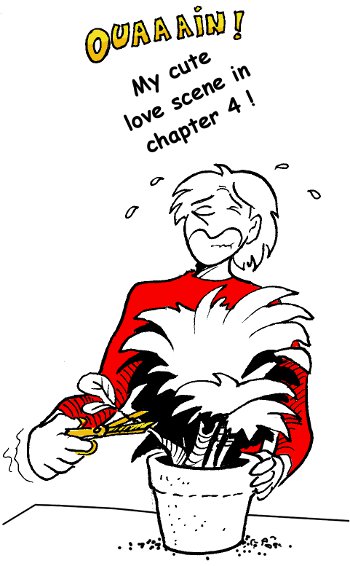
This is what usually happens to my inspiration when I take too long getting ready…
But don’t let this stop you from creating!

.
.
This is what usually happens to my inspiration when I take too long getting ready…
But don’t let this stop you from creating!

.
Dive in, my fearless fans!
(But in real life, always check the water depth before!)
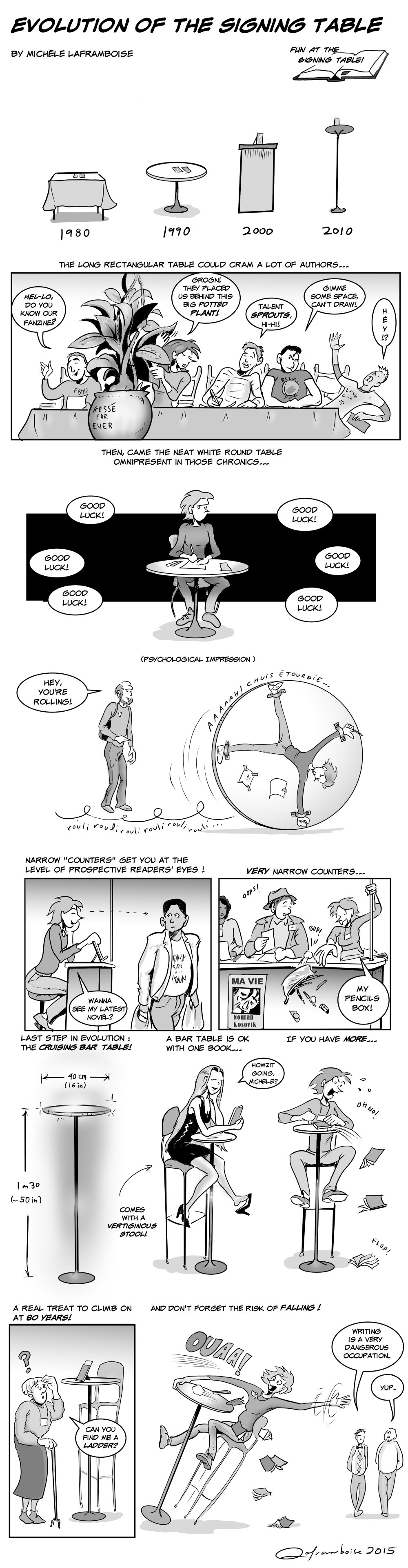
Here’s an overview of the works in progress and deadlines, for the edification of my fantastic fans.

Running towards new adventures and deadlines!
New SF short-stories completed in March (written on the laptop inherited from my dad, a SF lover):
– 2 in French
– 2 English
News in submission:
– 4 submissions to contests and magazines in the last two weeks. Includes three completed mentioned above, and an English translation of a new previously published.
New texts in progress:
– 3 English (end of March). I really enjoyed a 6-week workshop hosted online by Dean Wesley Smith. His writing philosophy was bang on my weaknesses. Down with procrastination!
Foreign language publications
– 1 in the Russian Supernovia review published in January.
Stories:
– 1 French, subject to competition in late February.
Novels
19th in the planning stage (50 000 words)
18th in writing, scheduled to end in early April (60 000 words)
17th accepted with corrections (27 000 words)
16th is currently in print
Comics
My graphic novel Wind Mistress: page 38,39,40, and 41 scanned 42-43 in production.
Caricatures
– this one illustrating this column, the first done since the departure of my father. Note that the nature of the land on which the artist threads changes fast. Hence the slope in the title, as in a learning slope.
-One caricature done at the beginning of 2015, in support of Charlie Hebdo.
The promised project that drags its feet:
The trees – which has not gone too far! since the 24-24 when I began it! It will be 22 pages… Tsssk, tsssk, tsssk!
Posted in Art, Science-fiction
Tagged art, novels, short-stories, work-in-progress, Writing
The Clarion foundation helps budding writers of genre (SF, fantasy, fantastique, horror) to develop and mature their style. I had the joy of being invited by Lynda Williams (the author of the Okal Rel saga) to write a few posts from my own perspective of a SF writer with comic artist.
So my first post was about extending our writing roots to achieve a deeper connection with the reader. The illustrations are my own.
The last one is an account of my big, fat, first novel and its endless incarnations!

I am working on four more writing posts. Coming soon: The secret well of ideas, a another take at the well-known fan question: where do you get your ideas?
Posted in Science-fiction, Writing
Tagged budding writers, literature, lynda williams, novel, Science-fiction, Writing, Writing advice
As a SF writer, research is an essential part of my work. But I sometimes do too much of it!

If the finished product is burdened with heavy lumps of exposition, those annoying scattered blocks will slow down the story – and the reader’s interest.
Many people saying “You know, I don’t like science-fiction” are often more afraid of those lumps, than they would be of a gripping story with warm-hearted characters affected by loyalty conflicts.
Even for fantasy world-builders, the internal logic of the magic-or-supernatural workings requires a fair amount of thinking. And, as magical as the world is, the story must be well grounded in reality. How many fantasy novels, for instance, demonstrate a total lack of knowledge about equine biology and maintenance? One of my friends, who raises horses and loves fantasy, is appalled by what she reads.
And some SF or fantasy authors, too proud of their word-building, dump large exposition blocks on the unsuspecting reader! “I suffered for my art, and so must you!”
Research is like an iceberg.

There is the emerged part, the novel that you enjoy. But whatever the number of pages, there is a larger, hidden part underwater.
Not enough research under it and your story collapses under the contradictions, impossibilities, logical errors and paper-thin characters.
But when the universes and societies are lovingly built, the strong foundation even allows other writers to participate in it! Two examples: The Darkover series by Marion Zimmer Bradley and the Honor Harrington series by David Weber have spawned many paper children.
According to the readers’ ages or familiarity with the concepts, the submerged part of the iceberg is around 90%. For a simpler story, you may choose to tone down the emerged part. A story aimed at children will be a smaller icebeerg. A vast work, like the Martian trilogy of Kim S. Robinson will be a huge iceberg!
Hal Clement, in my view, left more of his research over the waterline… But that was the good ol-days of science-fiction writing! I found Needle, aimed at young adults, captivating, even when the concept of “teen” and “young adult” did not exist at the time!
In my latest SF novel, La spirale de Lar Jubal, aimed at YA, I set aside about 99% of my painstaking research and physics calculations for the space station, to concentrate on the visual and dynamic aspects, and on the character’s conflicts.
Nevertheless, I put some visual information at the beginning of the novel.
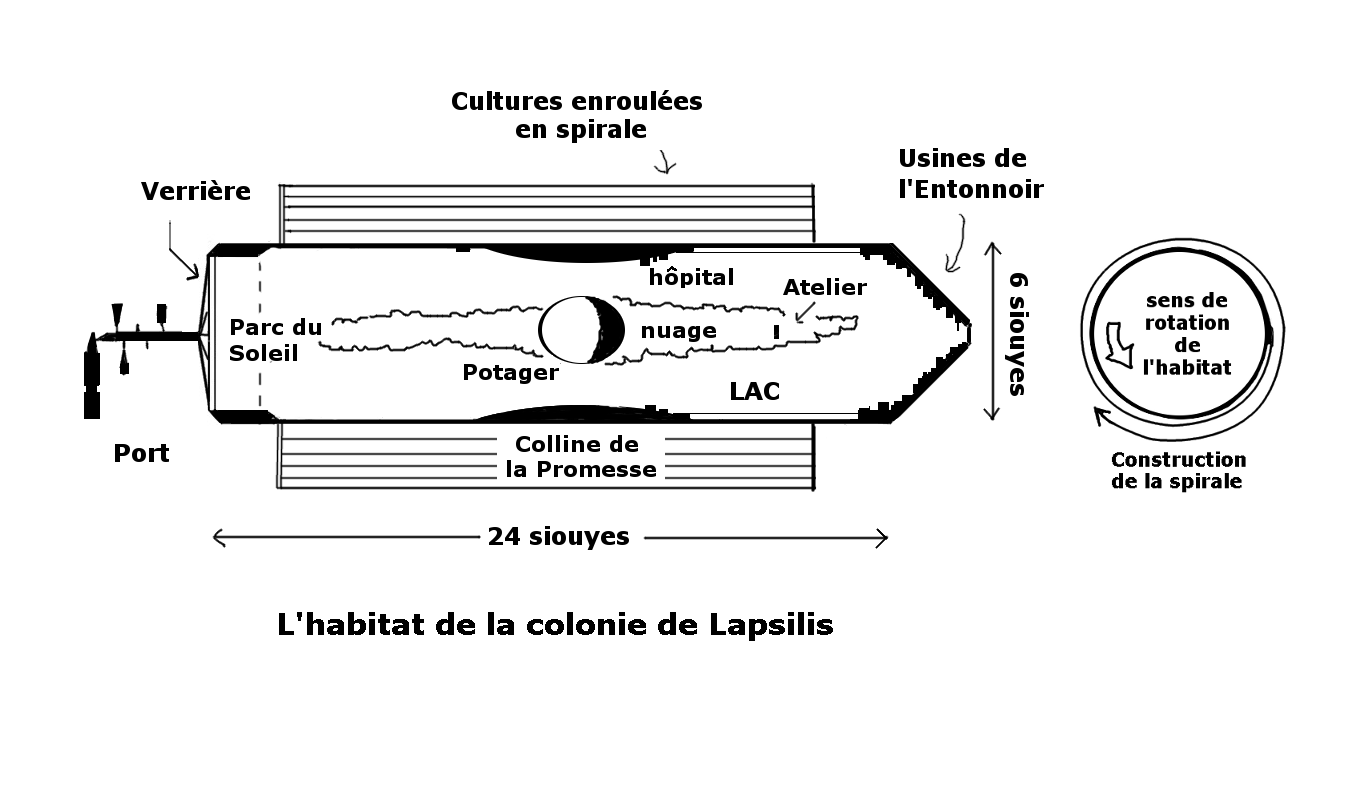
In my upcoming SF novel, aimed at the “Oh, I don’t like science fiction” crowd, there are very few numbers, but more active descriptions of stunning settings and actions. The planet and science aspects are explained only by their impact on the characters’ lives.
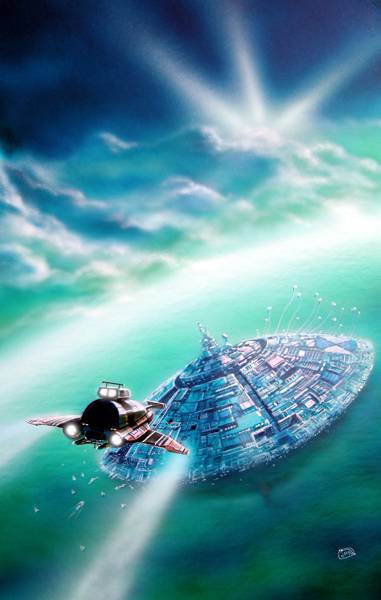
And I must manage, of course, the sense of wonder…as this Winds of Tammerlan novel cover suggests.
Another time, I will explain why science-fiction is like chocolate…
Posted in Science-fiction, Writing
Tagged budding writers, expository lumps, Les vents de Tammerlan, Science-fiction, Writing, Writing advice
The 2011 Clarion UCSD Write-a-Thon is almost over!

Since the Clarion overlapped the end of the Whittaker contest, I worked harder and produced more new texts… and some SF poetry! I did modestly on the Whittaker final tally (310 points) but was gratified by the production boost.
Here is my short fiction writing during the 6-weeks Clarion (counting two weeks of family vacation!) Feel free to visit my Write-a-Thon Writer page here to send a small contribution for the Clarion Foundation.
– The Robe (SF)
– Wrinkles (fantastic)
– A Short Stay at the Caracalla’s Resort (Dark SF)
– The Patroness (fantastic)
And for my current works in progress:
– about 10 000 words on the last novel in the Chaaas series
– near 5000 words on my next SF YA novel (52 000 words) to be published next February
– Writing on two short-fiction pieces in progress.
– Editing on the synopses on two other short novels
– Plus… 6 brand-new pages of a new SF graphic novel! (Extract here) I’m normally faster on the draw, but my free time is limited!
Posted in Science-fiction, Writing
Tagged Clarion, Clarion Write-a-Thon, graphic novel, Science-fiction, Whittaker Prize, Writing
A few short notices for April!
Working: on the fifth installment of the Chaaas’ Quest series, in French. I am developing the outline before getting to the actual writing. I am building new and exotic surroundings and exciting plotlines.

The Otaku ladies Webcomic is on hold until after the elections.
Freshly done: 10 pages of Kite Mistress, a graphic novel set in Chaaas’ Universe.
Translations: The first novel of the Chaaas’ Quest series has been fully translated in English. The second novel, Winds of Tammerlan, has been translated, and is waiting for its final revision.
My YA novel Les Nuages de Phoenix, (The Clouds of Phoenix) is being toted around in Mexico for a Spanish translation.
Adaptations: The Clouds of Phoenix exists in treatment form for a feature movie adaptation. One movie company refusal, so far. The three first installements of the series Chaaas’ Quest have their synopses and treatments ready, available from the author.
Making plans: The serialized graphic novel adaptation: 12 chapters of Chaaas’ Quest have been prepared and the first chapter have been broken down into pages. I choose a simple manga style as in The General’s Garden.
Tagged Chaaas, Comics, graphic novel, manga, Michele Laframboise, Movie adaptation, novel, Science-fiction, Writing
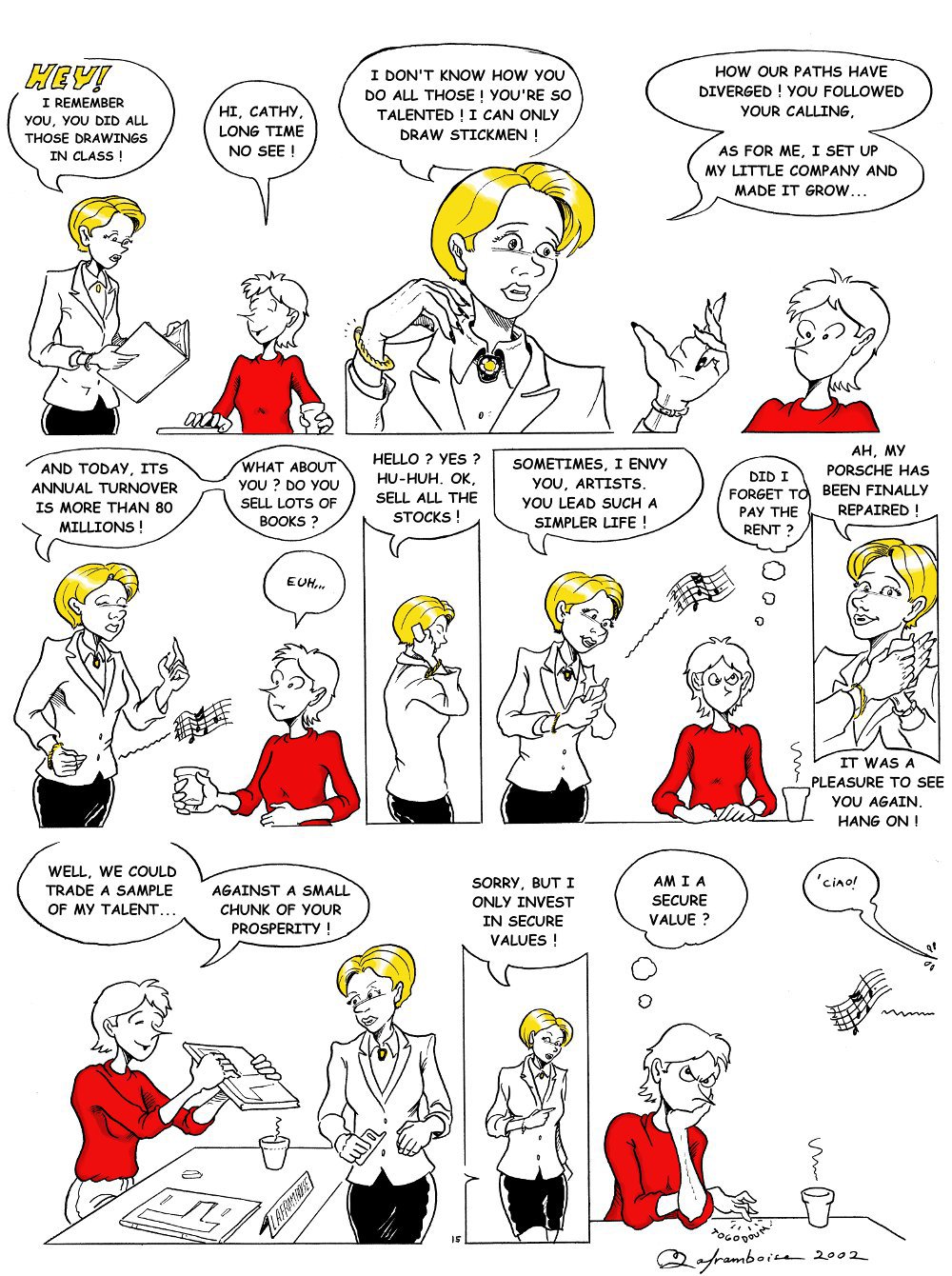
Has this situation happened to you?
Fortunately, none of my old college friends are afflicted with such a materialistic mentality. This meeting did not happen in a book fair, but at a dinner for young professionals at the Ecole Polytechnique. I was so well dressed that newcomers automatically takes me for a successful businesswoman. I had this same air as this comic character…then, it is when they realize that I am a humble self-employed worker that potential contacts shy away.
For some media, the value of an artist or writer is primarily related to his or her financial success.
I do not scorn entrepreneurship itself, since I lead my own business. In a recent lecture given at a dinner of the AFAF, I mentioned that building a business, any kind of business, requires a good dose of creativity!
SF and fantasy author Dean Wesley Smith (a prolific author who gives advice to young writers, his site is worth a visit) takes writing as a serious business. According to him, if you do not make a living from your writing, it is because you do not write enough or want it, work hard enough. This appears like a disdainful view of people whose productivity do not match his own. But the reasoning works also to remind us that we often find excuses for… not writing.
Well, there is an area for nuance or discussion, and all our situations and writing goals are not the same. I like to dig a lot of infos for my SF novels… besides doing comics as well. DWS believes in writing a lot, and submitting a lot, and taking care of the business end. With a hundred novels published in twenty years or so, he is an Olympic writing athlete himself! (A page in 10 or 15 minutes… faster than me, even when I have the story clear in my head).
This year, he gave himself the challenge to write 100 short stories for 2011. Yes, a hundred! There is already eight published, between 2500 and 6000 words each. It is fortunate that he repeats that every writer is different! Nevertheless, his blog “Killing the sacred cows of publishing” offers great pointers and unorthodox advices.
DWS is very optimistic. In his opinion, publishers are always looking for new voices. And that too much rewriting “blunts” your creative voice, the personal, original part of the creation.
It happened to me for my first novel Ithuriel (16 agonizing rewrites!), so his message resonates strongly with me. Obviously, DWS revises to correct the “ortograf”, or flagrant errors or blunders. But after that he rewrites only if his editor asks him. And after the contract is signed…
It was a stimulating reading for me. Dean Wesley Smith’s advices have the effect of empowering a writer, reminding that he or she is not at the mercy of “the market” or agents. And to put the pleasure back in writing. Writers can achieve a good measure of “success” with effort and perseverance, without sacrificing their unique voice.
:^)
Posted in Comics, humor, Science-fiction
Tagged Business of writing, Comics, Dean Wesley Smith, humor, novel, Science-fiction, Signing table, Writing, Writing advice

There comes a point in writing where we feel that the story, the players and the universe that hold them have gained enough consistency to secure them in a tangible form. The ethereal cloud of infinite possibilities must now be condensed, into a brick (but not a too thick one!) Of course, there will always remain a small cloud of regret…
How to take this step without too much pain?
As I explained in another post, I do not have a rigid plan. I rather draw a grocery list. Here is one of the subplots in a novel work. (It does not give the big punches, and if you can’t read French, my secret is safe, bwa-haha!)

I draw clouds of relationships between characters, and do the research to comfortably establish my imaginary world.

An imaginary world well designed, whether in science fiction or in fantasy, do not only allows the author to return to it, but fans can also seize it (it happened with the universe Darkover by Marion Zimmer Bradley).
CAVEAT: Research is good, but … to some extent!

This is me writing a science fiction novel! Alas, too much “let’s google this, check up that” in the middle of writing the first draft of a manuscript will cut your swing, slow or even paralyze you. Oh, I wanted to read this post by Cory Doctorov sooner!
When you’ve worked and thought and lived with our stories behind the head, the characters grow and eventually become almost friends to the writer.
After the throes of planning is a very pleasant step in creating a novel. In my case, I enjoy doing lots of sketches that show a little life characters “outside” the scope of the novels. Here, I sketched a family scene from the world of Chaaas.

The downside is that it might push the story in all directions. And as it happens while I am writing, the manuscript gets longer! We must rein in those ideas, and jot down the wildest ones to recycle them for another story!
As the publishers have a specific format in mind for their books, there is usually a limit of pages to follow. We must strive to keep one or two main plot lines and give up many ideas and developments full of promises … with no guarantee that all the children of our imagination will emerge elsewhere!
Posted in humor, Science-fiction, Writing
Tagged ideas, Michele Laframboise, plot lines, Science-fiction, Secret well of ideas, Writing, Writing advice





 Echoes of a Sunday artist