Tag Archives: Climate change

An Evening with Jane Goodall in Toronto

The screen in vivid green that greets us. I love the little Africa-shaped pendant!

That Wednesday should have been an ordinary middle-of-the-week day. Except for those two words uttered by my morning radio program host: Jane Goodall. Plus: Toronto this evening.

I stopped everything I was doing to get the venue. Jane Goodall was coming to Toronto.

For someone like me who have been fascinated with ants and nature since a toddler, who could be found at the crown of any tree, who still goes out with a pair of binocular to watch the skies, Jane Goodall, who started her magnificent, long-standing work studying chimpanzees the year of my birth, and this, without a diploma, is a heroine.

So what if the transit from my place to the Meridian Hall took more than two hours and a half? I bought one ticket and off I went, in the middle of the afternoon, to see a legend. Getting there was a bliss, apart for the hurdle of eating something, anything, before the speech. The Meridian Hall offered drinks and food, but I didn’t know it and lost stomach-grumbling time at a café, before deciding to use some plastic for a hearty beverage.

Somehow, I had bought a seat very well located. I sat in an ambiance filled with the quiet sound of a distant jungle.

The introduction is done by five young people of the Foundation, which count a Canadian branch. Because, this is not only about African countries, but everywhere. If you do not respect the first Nations who took care of the land, you can’t heal the same land.

That is the lynch point of the Institute : you can’t protect the environment while ignoring the needs of the people residing on the earth. You can’t come to a village where the children are hungry and tell them what to do. All projects of Jane Goodall Institute involves the people living on the territory.

When we put local communities at the heart of conservation, we improve the lives of people, animals and the environment.

Jane as a storyteller
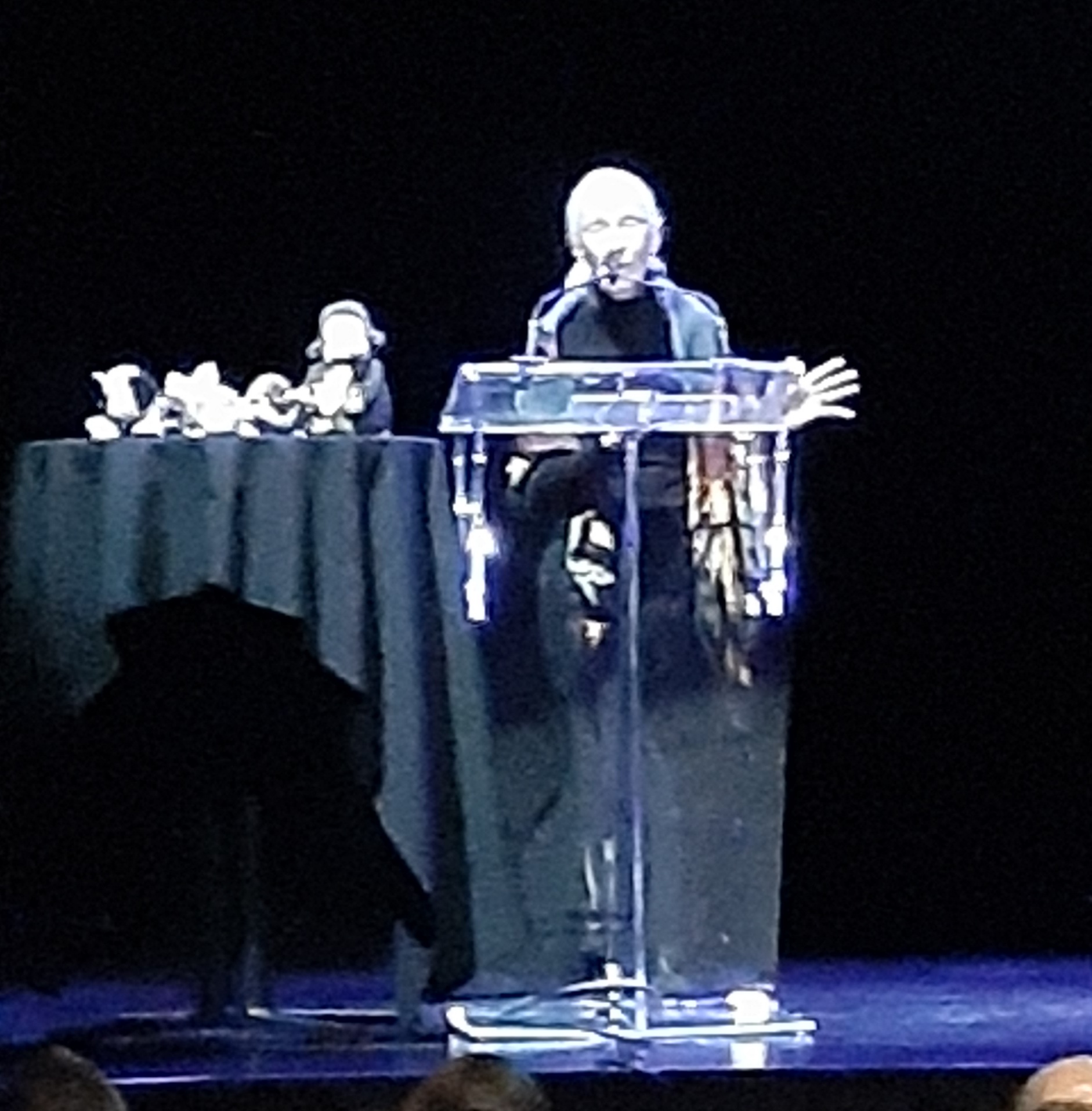
Jane, was finally introduced in a thunder of applause. At 91 years-young, she walks without aid and talks with enthusiasm. Jane Goodall gave an electifying, uplifting speech in Toronto.

She regaled us with anecdotes from her childhood in Britain, of growing up in WWII with rations, reminding us that TV had not been invented at the time. Her mother and aunts were very liberal, letting the little girl roam, and not calling the police when little Jane disappeared for four hours, finally emerging from the coop because she wanted to see how the hens could produce their big eggs!

(I did disappeared once. I had been playing with a friend in the parc, and she had invited me at her home to play, and I ended up staying for supper. On my return to our apartment block, I found two police cars and my mother frantically gesturing. Did I warn her ? Oops.)

Nature fascinated the little Jane, and she knew she wanted to be near animals. At ten, she was a ravenous reader, and one day, she found a novel that embodied all the adventure she dreamed of. Tarzan of the Apes. She fell in love with the “Lord of the Jungle” until…

He wedded the WRONG JANE!” she said, sending all of us roaring with laughter.

At a point, she was invited by a relation to Africa, and worked as a waitress to save for the boat ticket (there were planes, but too expensive and rare.) And finally, she got her first contact with Africa, South Africa to be precise.

She returned home, eager to get a job close to the animals, but without a diploma? Eventually Louis Leakey invited her to assist as a secretary. And she got introduced to scorpions, snakes, baboons and,… an ambling rhinoceros! On those occasions, she managed to stay calm, that prodded Leakey to assign her to observing the chimpanzees. Without a diploma.

But here was a problem, In 1960, letting a young woman alone in the jungle (even with a crew) was a no-no. So, who came to chaperone Jane?

Her MOM! Yup, she stayed as long as necessary, even if the elder Goodall did not care for the scorpions, snakes and various samples of the local fauna. But she managed to write (she was a novelist) and even opened a small clinic to dispense very basic band-aid care.

And so, her marvelous work started to gain attention with the National Geographic endorsement that came on… July 14th, 1960. Ahem.

Keeping Hope

Jane is not blind to the current world state, and she mentioned the war and genocide occurring in Ukraine, Soudan and Gaza. His interviewer, radio host Georges Stroumboulopoulos, tells her: You’re not afraid to say that? And she replied: I don’t care (who is offended.)

I didn’t know, but Jane, who was vegetarian for a long time, has become vegan since a few years, like Georges is. She showed us plush animals, a chimpanzee, an octopus, a pork, a jungle rat, each having intelligence and capacities. Farm animals are sentient, and often sapient, too. We can act, in things as small as consuming a plant-based diet, better for the animals and the planet.

How can you stay so hopeful when the world is burning? (Nor exactly that phrasing). Jane gives us the reasons;

First, the younger generation is growing up and resilient. Second, the human indomitable spirit and our intellect that can find solutions to problems.
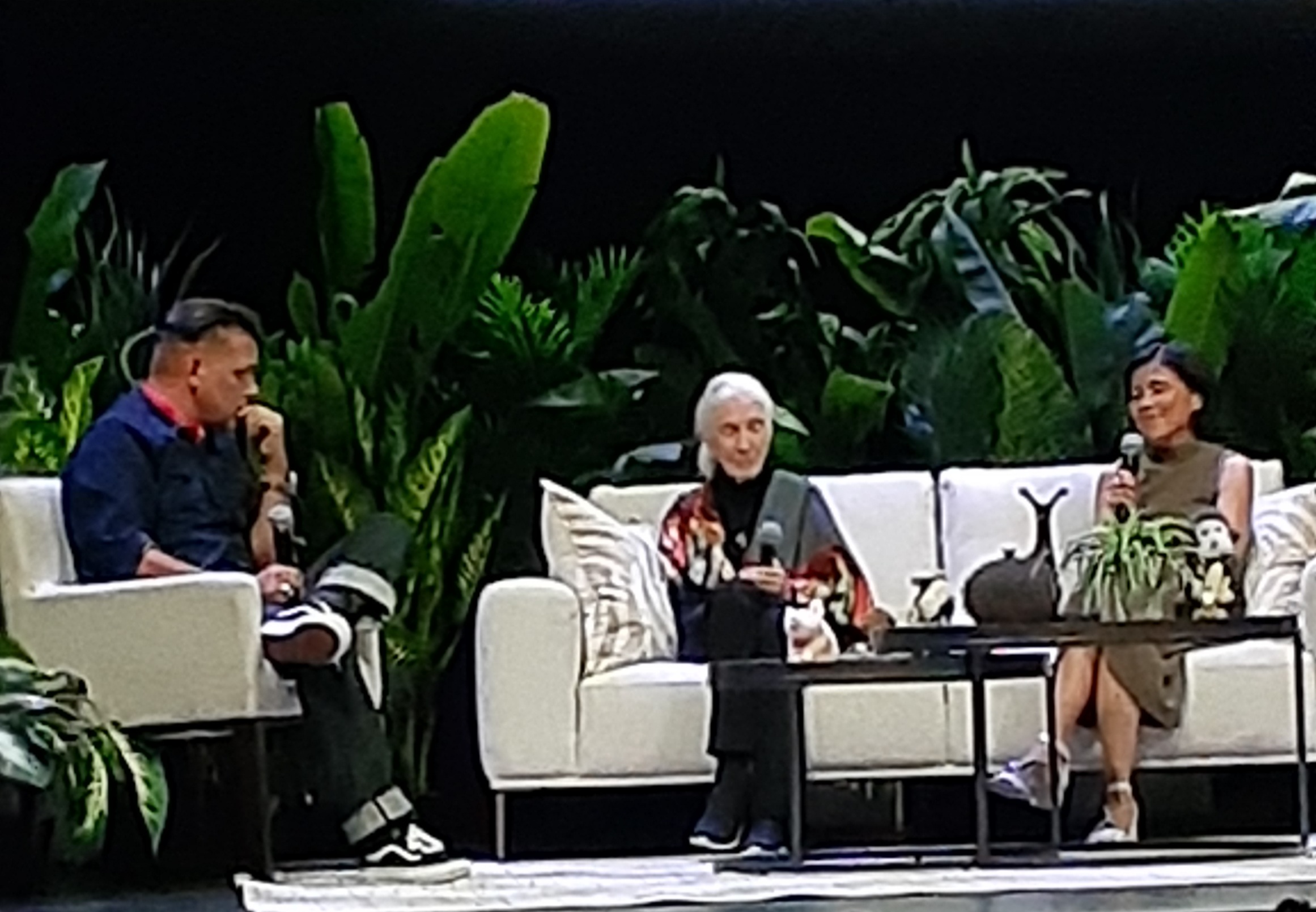
Photo from my seat. Georges Stroumboulopoulos, Jane Goodall, and the head of the Institute in Canada.

And she added uplifting examples of hope: of children planting trees in war-torn countries, of the Gombe forest (in Tanzania) that had almost disappeared due to over cut in the 1980s, and that grew back on the hills. Roots & Shoots is a global youth leadership program that exists in more than 140 countries. Through Roots & Shoots, participants identify and address problems in their communities.

Helping people to improve their lives also helps the nature around. And do not stop acting to the best of your knowledge, to help people, the environment and the animals. Even in small things.

I left the Meridian Hall in a happy mood. It was worth the five hours total of public transit.

To discover more about the Jane Goodall Institute, go here. And for more words of hope, go below!
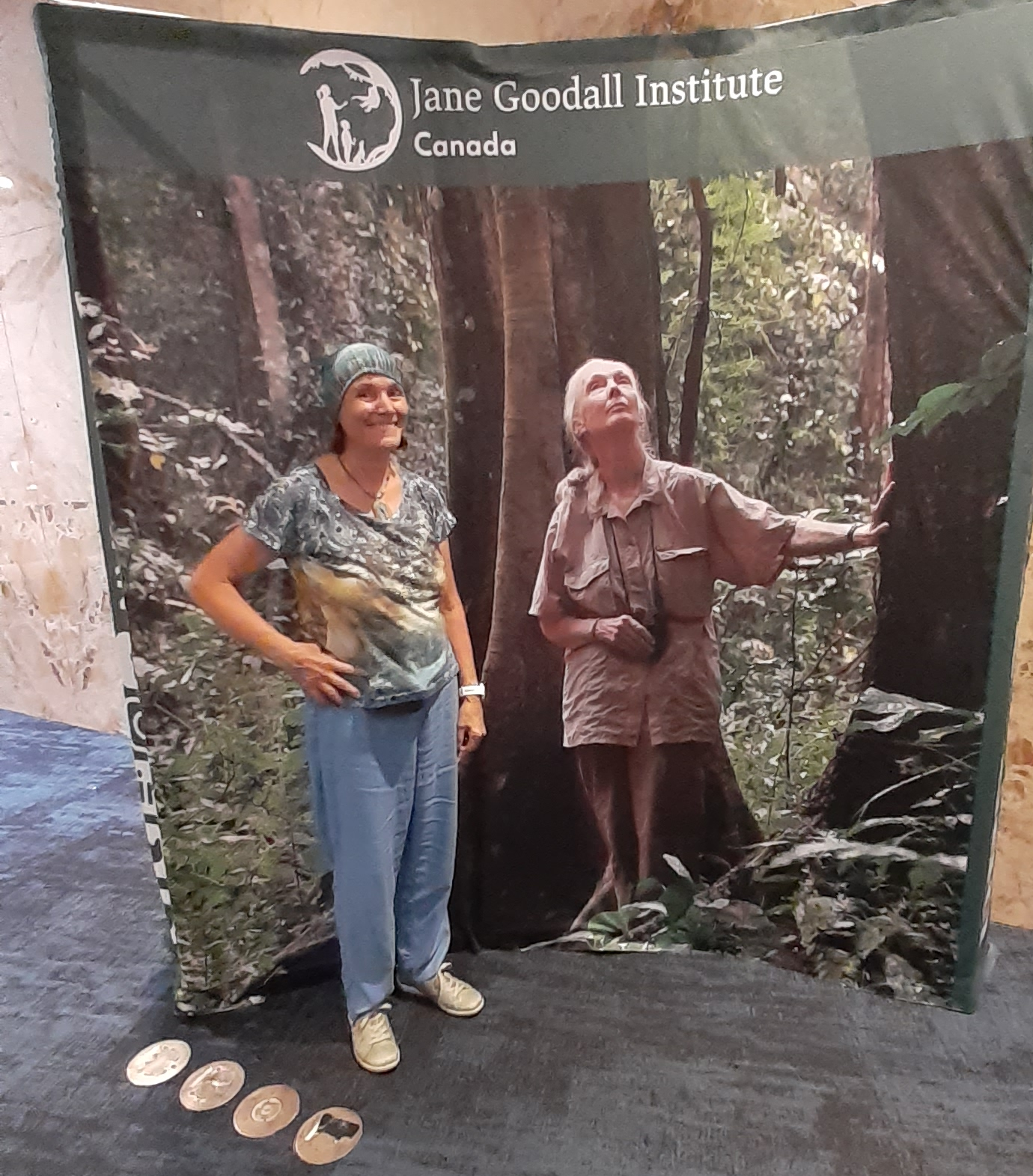
A fun little picture with our heroine. (Of course, nobody wants to crowd Jane, so this is good solution.) Pic taken by a nice visitor, Lisa.

The Sunday Artist is Michèle Laframboise, artist and SF writer.
Image

Winter Gardening

DecemberGardening

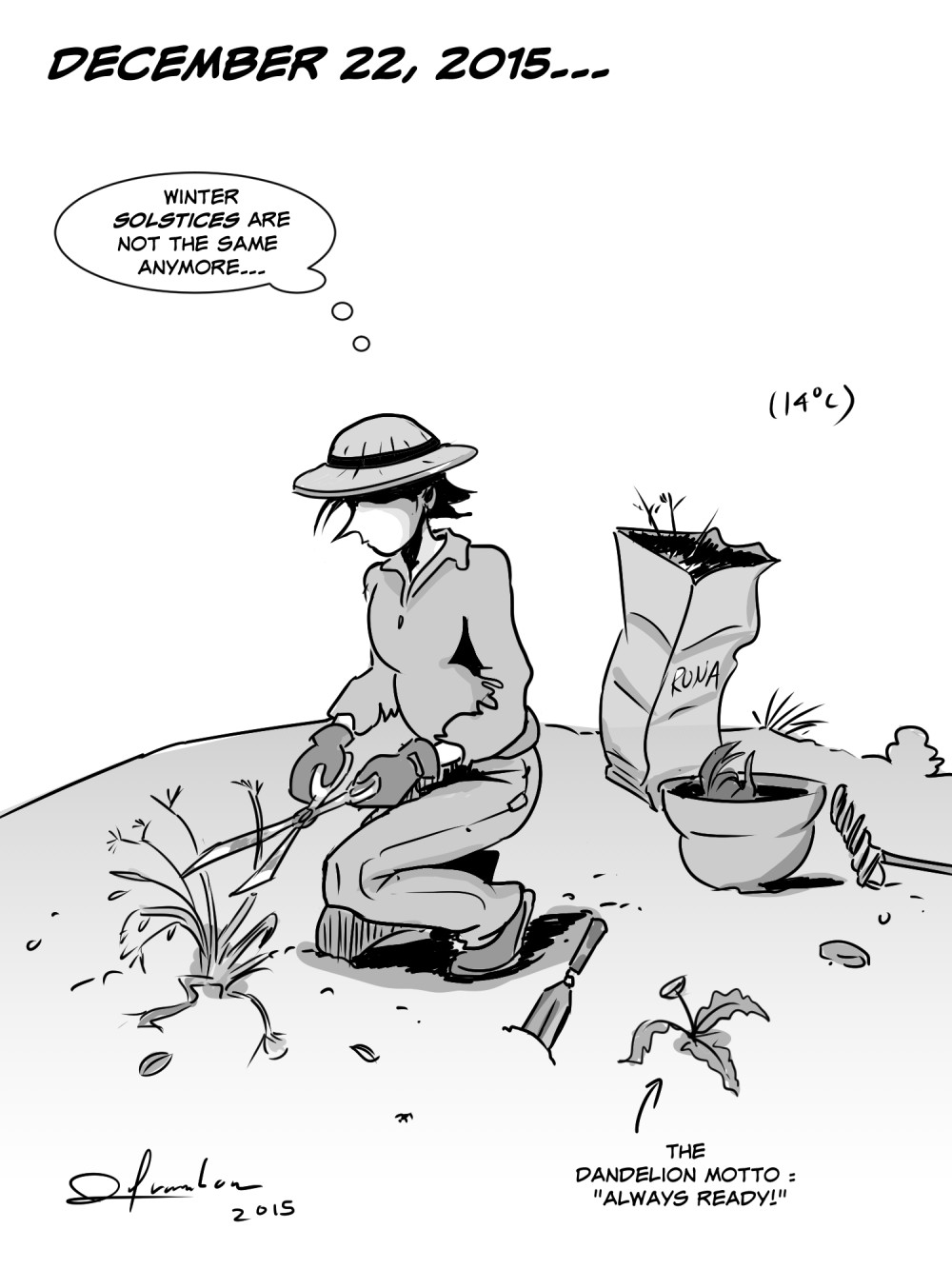
Yes, a heat record for the Toronto area! The winter solstice has changed…

Fun at the Signing Table – A Glass of Water

.

A Glass of Water - how to explain the glooal climate change with a glass of water.

.

The relation between our recent cold weather spells and global warming involves complex phenomena, the Gulf Stream current among them. For the more eager :

To better understand our irrealists expectations regarding science, conditioned by our “I-want-it-now!” culture: The Problem with Science: from Action Movies to the Real World!

For a innovative use of our fossil resources to mitigate the climate change, see une solution au casse-tête arctique.

To read about the projected effects of a Shutdown of thermohaline circulation, and here is a map of the thermohaline circulation.

For a more higher level paper, about the Gulf Stream, see this abstract of a paper published in 2015 by Jaime B. Palter, from the Department of Atmospheric and Oceanic Sciences of McGill University: The Role of the Gulf Stream in European Climate (Annual Review of Marine Science Vol. 7: 113-137) 

The real demonstration will be given by the planet, as soon as the last ice and land glaciers will have melted.

The Problem with Science : from Action Movies to the Real World

Climate and pollution: two distinct issues?

Earth, in pain, or in denial

A science-fiction author cannot help but follow the sciences as closely as she can, and observe the trends in controversy.

The last trend in climate change denial has come : informed journalists are now telling ecologists to stuff it, er… “focus on the real issues” (pollution, smog, loss of natural habitats) instead of global warming. While saying that the Kyoto, Copenhagen and Cancun meetings “were/are a waste of money”, they guide their environmentally-conscious readers to separate the good wheat from the useless chaff.Thinking in separate compartments

This thinking presupposes the existence of two separate file drawers: one called “climate” and the other “pollution”,  that cannot be opened at the same time. The same journalist berated environmental associations for exclusively working on GW and ignoring any other concerns. “Now that global warming has stopped sucking all the oxygen out of the room, some of those who care about the planet will turn to other – and more pressing – problems.” (The Globe and Mail)

So, all the time-consuming work about protecting fragile habitats, animal-flora rich wetlands and tropical forests done over the years by environmental associations, and even the very down-to-earth work by local volunteers, are conveniently swept under the rug.

Newsflash: if you worry about the loss of habitats, any climate change will affect those habitats all over the globe. The divided compartment mentality does not reflect reality. This reflex also come from our own cultural expectations.

The problem with science…

Armageddon movie poster: aaah, at last, a real, non deniable threat!

… is that science does not work like it does in American movies.

In any scientific thriller, the hero or group of scientists investigating a problem identify the cause in about thirty minutes, one hour tops. They find a working solution maybe twenty minutes after, and apply it, or synthesize the remedy, in less than 15 minutes of happy or tense viewing. In a dramatic climax, the world is saved in a nick of time! Even if the movie time frame is formatted, viewers get conditioned to expect “simple solutions, NOW!”

In Armageddon, there was no trouble identifying the rather large and obvious threat. No problem to get all governments acknowledging the threat.  There were some religious apocalyptic manifestations, but there were no groups claiming the coming asteroid is a hoax, no private industries funding “asteroid denial” websites. And the scientists worked seamlessly together to  prepare the solution.

If only the impact of our carbon emissions were that obvious to the naked eye… as are the agricultural landscape changes over two centuries.

In the real world…

Science is not, I repeat, not sexy. Neither fast.

Any research takes years, and scientist are trained in high specialization field. (My own M. Sc. memoir is about the Origin and evolution of two southwestern Quebec black soils* and deals with pollen sampling and reconstitution of the past environments of wetlands. By the way, those southern wetlands areas are shrinking fast).

The everyday work of in research, with the security measures (note the goggles, gloves, and the vent to evacuate the fumes)

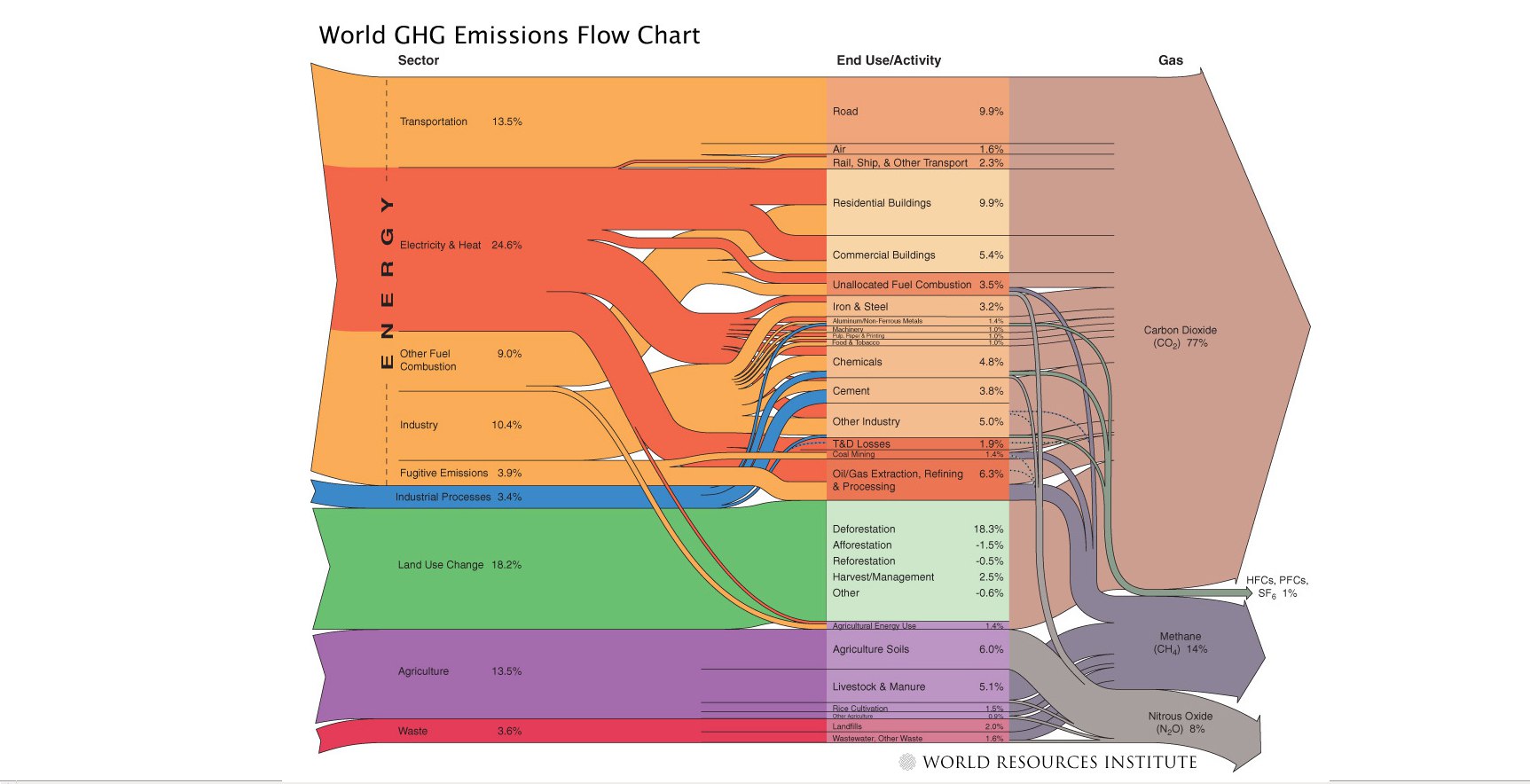
Each research group work first on their own, publishing their results after a grueling process of checking and a peer review.  Annual conferences see thousands of researchers share and discuss their findings. For a problem of the magnitude of climate change, just getting the world governments to acknowledge the issue, then acting on it, required a staggering amount of work. Even a simple graph like this one needed a lot of data to build upon.

World GHG Emissions Flow Chart

So, no wonder the companies washing their hands from the climate change had a field day cherry-picking small discrepancies, glitches, approximations in the compiled results from more than 3000 researchers, aides, plus the several hundreds of individual studies recording global warming impact since 10 years. The so-called Climategate still makes the rounds on denial sites, even after investigations have cleared the research unit involved.

Few hard-working Janes and Joes can find the free time to check and counter false arguments, whereas millions are funneled to climate change denial websites and front “Institutes” muddying the waters with phony arguments or false rumors no one has time to check out. I once spent three hours to properly and scientifically deconstruct one false argument, but whatever balanced answer I produced was drowned in a sea of simplistic assumptions. Similar attacks on sciences come from the neo-creationists corner. Flat-Earth theory supporting websites (The round planet is an elaborated hoax!) can’t be far behind…

The problem with scientific arguments is that most humans react by emotions, mainly fear, rather than reason, especially when their lifestyle, beliefs and comfort are challenged. (Of course, all the denial websites boast that reason is on their side, and the others are fear-mongering groups with a world-domination agenda…)

A well-known psychological test showed that faced with two choices, either gaining five dollars NOW or waiting two weeks to get 10$, most people chose the the security of having the 5$ bill NOW, and who care for later? Any trade-off between short-term discomfort and long-term advantage has to get a powerful motivation. Like preserving the biosphere.

Anything challenging our present comfort zone is viewed with skepticism. It happen in any field: for instance, the link between smoking and lung cancer has been questioned… by tobacco industry experts.

If climate scientists had presented the problem along those lines:

The climate is a-changing
but fossil fuels are not the cause
there is a simple solution
that will only cost pennies
to tax-payers
and gain hefty profits
for enterprises
no one would have
to change anything
to their lifestyle

There wouldn’t be any climate change denial groups. (No more than “round planet hoax” denial sites.)

So, whether you believe in AGW, or simple GW without this horrible guilt-inducing “A” (anthropic), or not at all, let us focus on something else that will bring warm memories. Let’s go back to a time when the dreaded long environmental word was not widely used, when the problem was both obvious and (relatively) simple…

A clue from the past: pollution!

smog

We have since 1960 witnessed and document signs of environmental damage, destruction of natural habitats, loss of biodiversity, smog-related health problems, etc. The last 50 years, fossil fuels and car companies were repeatedly warned by the scientific community of the consequences of their gas emissions.

Did they lift a finger?

Did they put accessible electric cars on the market in the 70s to counter the well-known smog? The 80s? The 90s? No. Not because those companies harbor malignant intentions toward the population, but because of inertia and the ever-expanding value of the remaining oil.

The dynamics of acid rains

The dynamics of acid rains

Later,  fluorocarbon emissions problem began destructing our protective layer of  ozone, the acid rains killing our maples.

In each of those cases, there was some denial at first, and the concerned citizens had to work harder to raise awareness on those issues. When the companies agreed to some mitigating measures, it was only when pushed to the wall by the consumers and the governments. And, driven by the same economic forces, they put out green lies if they can get away with it.

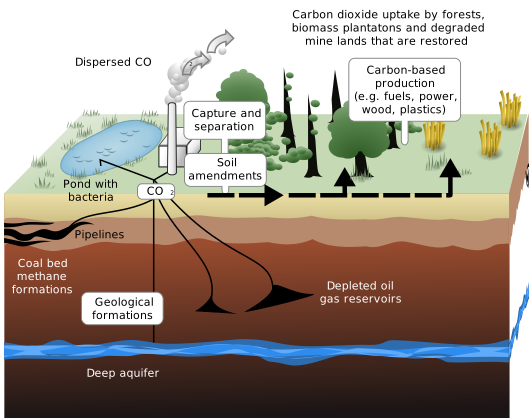
So, their past behavior about pollution being a clue, the major companies and carbon emitters will not be inclined to cut their profitability or change their ways (except if governments fund their research for greener fuel extraction methods or carbon capture).

Schematic showing both terrestrial and geological sequestration of carbon dioxide emissions from a coal-fired plant. Rendering by LeJean Hardin and Jamie Payne

Instead, they will plunge in their  deep pockets to finance sites leaning their way, for as long as the oil runs. And the oil can run for a long time… if we stretch the resource hard enough.

And a glimpse of a future

There is another advantage for companies to bury their head in the (tar-)sands and “wait out” the crisis.

When the consequences of global warming – along with good ol‘ pollution –  will become un-deniable, when arable lands will be wasted through accelerated nutrient-depletion by over-cropping and desertification processes, along with the political turmoil that will only get worse, with the middle-class crunched under the economic wheel and millions of refugees bounced around… only the powerful will be able to buy their way into the few remaining pockets of untouched land.

In their secluded retreats, they will look upon the desert via their remote cameras, rewriting history. And they will record this fate:

the Earth diedDried-up Earth
from natural causes.

*

As for the rest of our descendants… Well, at least, there will be no more controversy !

Living in a bunker...

*

The full reference of my Master’s Memoir:

Laframboise, Michèle, 1987. Origine et évolution de deux terres noires de la MRC du Haut-Saint-Laurent. Mémoire de M. Sc., Département de géographie, Université de Montréal, Montréal, Québec. 94 pages. Directeurs: Paul Comtois et Pierre J.H. Richard.