Sense of Wonder – portrait of me discovering SF at 12, in my father’s library

Sense of Wonder – portrait of me discovering SF at 12, in my father’s library
This June 5th, I managed to show the Venus transit to our eager cubs. This safe projection from the telescope shows Venus and even some sunspots (very small). Note the orientation at right angle, facilitating the observation.
Lugging a scope in a park on Venus transit evening make you very popular among passer-by!
(Closer view; those pics were taken by a friend)
But the real magic moments were when birds (or planes!) crossed the enlarged sun projection.
The Clarion foundation helps budding writers of genre (SF, fantasy, fantastique, horror) to develop and mature their style. I had the joy of being invited by Lynda Williams (the author of the Okal Rel saga) to write a few posts from my own perspective of a SF writer with comic artist.
So my first post was about extending our writing roots to achieve a deeper connection with the reader. The illustrations are my own.
The last one is an account of my big, fat, first novel and its endless incarnations!
I am working on four more writing posts. Coming soon: The secret well of ideas, a another take at the well-known fan question: where do you get your ideas?
Posted in Science-fiction, Writing
Tagged budding writers, literature, lynda williams, novel, Science-fiction, Writing, Writing advice
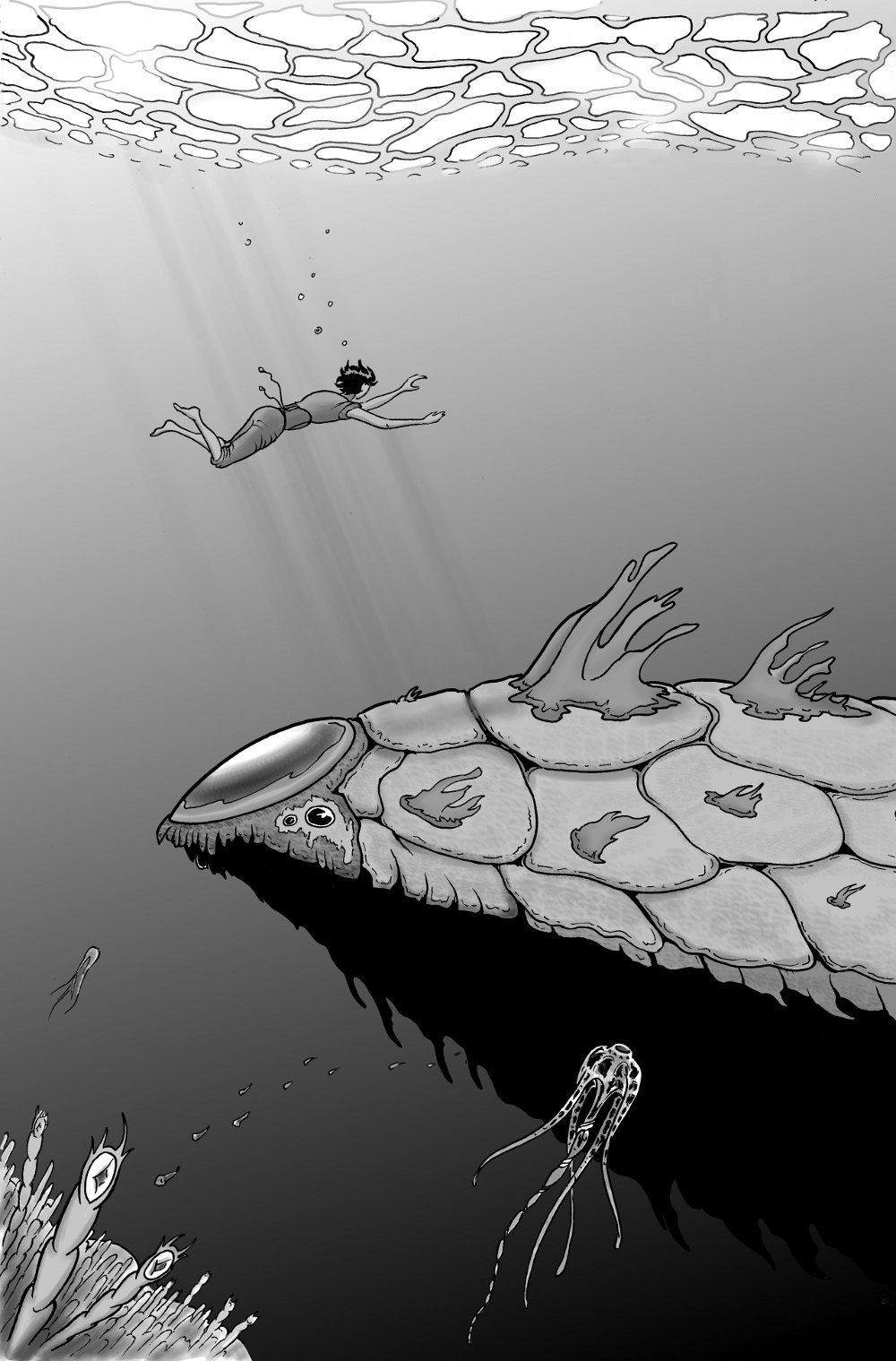
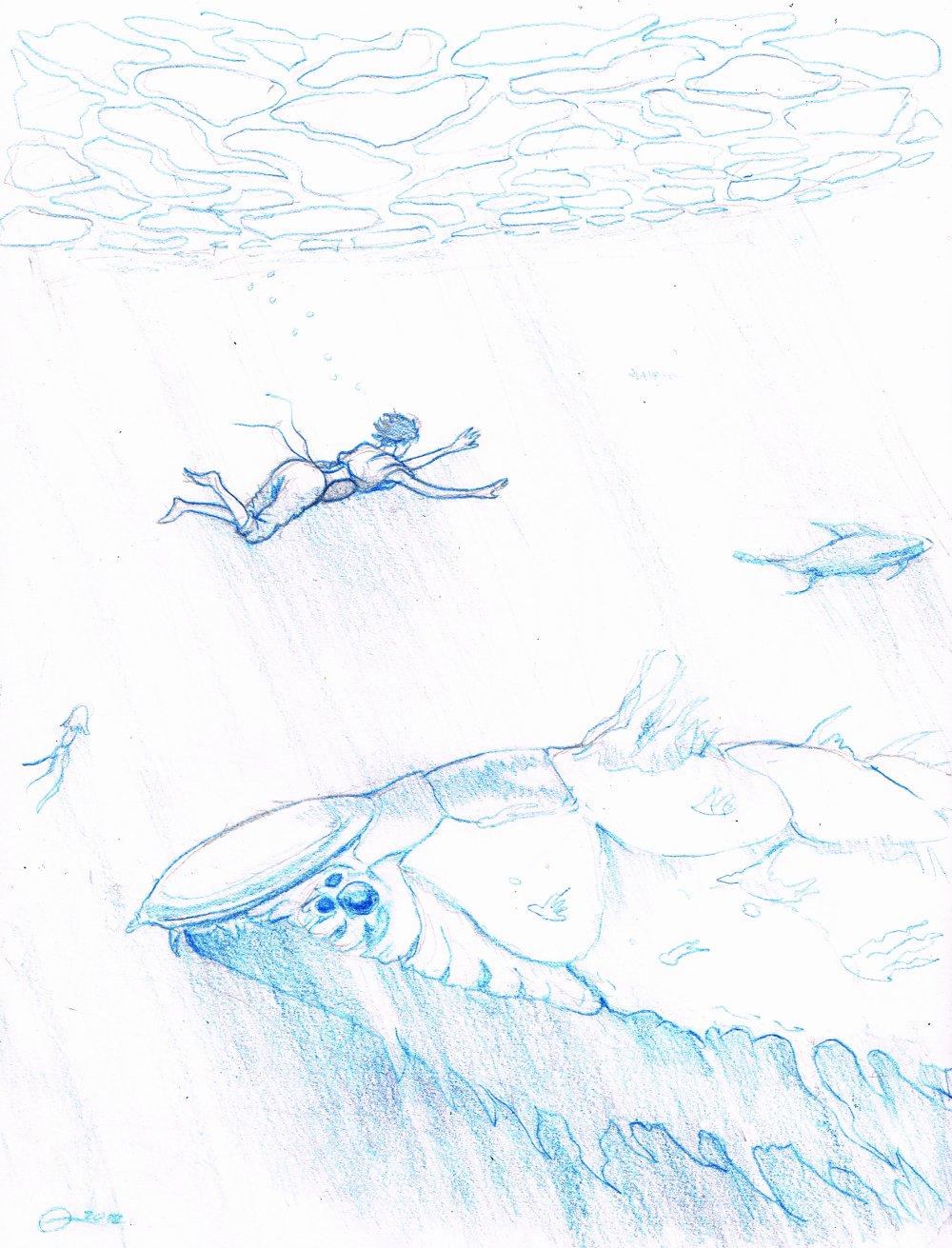
This is a sketch that I did yesterday evening. It is a glimpse of my upcoming SF comic Wind Mistress, featuring a young girl named Adalou. The result may look a bit pale and dreamy, but I boosted the colors after scanning the original drawing !
Drawing a ponderous aquatic creature was a challenge. The oriented light rays help giving the image its depth and placing the volumes.
Posted in Art, Science-fiction
Tagged aquatic monster, Comics, drawing, Science-fiction, sketch, YA science-fiction, young girl
As a SF writer, research is an essential part of my work. But I sometimes do too much of it!
If the finished product is burdened with heavy lumps of exposition, those annoying scattered blocks will slow down the story – and the reader’s interest.
Many people saying “You know, I don’t like science-fiction” are often more afraid of those lumps, than they would be of a gripping story with warm-hearted characters affected by loyalty conflicts.
Even for fantasy world-builders, the internal logic of the magic-or-supernatural workings requires a fair amount of thinking. And, as magical as the world is, the story must be well grounded in reality. How many fantasy novels, for instance, demonstrate a total lack of knowledge about equine biology and maintenance? One of my friends, who raises horses and loves fantasy, is appalled by what she reads.
And some SF or fantasy authors, too proud of their word-building, dump large exposition blocks on the unsuspecting reader! “I suffered for my art, and so must you!”
There is the emerged part, the novel that you enjoy. But whatever the number of pages, there is a larger, hidden part underwater.
Not enough research under it and your story collapses under the contradictions, impossibilities, logical errors and paper-thin characters.
But when the universes and societies are lovingly built, the strong foundation even allows other writers to participate in it! Two examples: The Darkover series by Marion Zimmer Bradley and the Honor Harrington series by David Weber have spawned many paper children.
According to the readers’ ages or familiarity with the concepts, the submerged part of the iceberg is around 90%. For a simpler story, you may choose to tone down the emerged part. A story aimed at children will be a smaller icebeerg. A vast work, like the Martian trilogy of Kim S. Robinson will be a huge iceberg!
Hal Clement, in my view, left more of his research over the waterline… But that was the good ol-days of science-fiction writing! I found Needle, aimed at young adults, captivating, even when the concept of “teen” and “young adult” did not exist at the time!
In my latest SF novel, La spirale de Lar Jubal, aimed at YA, I set aside about 99% of my painstaking research and physics calculations for the space station, to concentrate on the visual and dynamic aspects, and on the character’s conflicts.
Nevertheless, I put some visual information at the beginning of the novel.
In my upcoming SF novel, aimed at the “Oh, I don’t like science fiction” crowd, there are very few numbers, but more active descriptions of stunning settings and actions. The planet and science aspects are explained only by their impact on the characters’ lives.
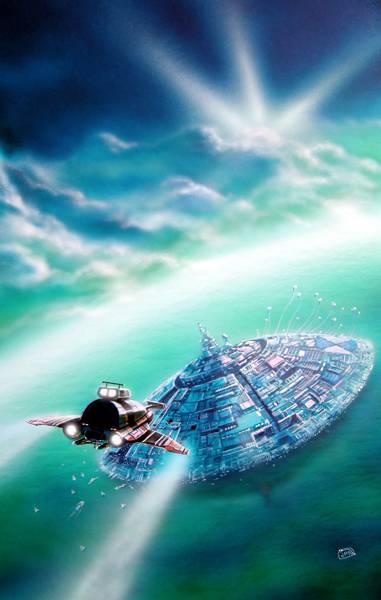
And I must manage, of course, the sense of wonder…as this Winds of Tammerlan novel cover suggests.
Another time, I will explain why science-fiction is like chocolate…
Posted in Science-fiction, Writing
Tagged budding writers, expository lumps, Les vents de Tammerlan, Science-fiction, Writing, Writing advice
Here is another page that gave me a lot of work in all the stages! Drawing cluttered interiors is the bane of my art!
This page was finished in greytones with Gimp 2.6 and my trusty Wacom Intuos tablet. The perfectionnist, I even put in a late perspective correction in the last panel!
Read the rest of this installment in Destination Nexuz3!
Posted in Art, Comics, humor, Science-fiction
Tagged Adalou, Comics, Gimp software, greytones, Intuos graphic tablet, manga, Michele Laframboise, Science-fiction, work-in-progress