Category Archives: Writing

2011 Clarion Write-a-Thon update

The 2011 Clarion UCSD Write-a-Thon is almost over!

The earnest SF writer working on her projects

Since the Clarion overlapped the end of the Whittaker contest, I worked harder and produced more new texts… and some SF poetry! I did modestly on the Whittaker final tally (310 points) but was gratified by the production boost.

Here is my  short fiction writing during the 6-weeks Clarion (counting two weeks of family vacation!) Feel free to visit my Write-a-Thon Writer page here to send a small contribution for the Clarion Foundation.

– The Robe (SF)

– Wrinkles (fantastic)

– A Short Stay at the Caracalla’s Resort (Dark SF)

– The Patroness (fantastic)

And for my current works in progress:

– about 10 000 words on the last novel in the Chaaas series

– near 5000 words on my next SF YA novel (52 000 words) to be published next February

– Writing on two short-fiction pieces in progress.

– Editing on the synopses on two other short novels

– Plus… 6 brand-new pages of a new SF graphic novel! (Extract here) I’m normally faster on the draw, but my free time is limited!


Works in progress

A few short notices for April!

Working: on the fifth installment of the Chaaas’ Quest series, in French. I am developing the outline before getting to the actual writing. I am building new and exotic surroundings and exciting plotlines.

Otaku Ladies

The Otaku ladies Webcomic is on hold until after the elections.

Freshly done: 10 pages of Kite  Mistress, a graphic novel set in Chaaas’ Universe.

Translations: The first novel of the Chaaas’ Quest series has been fully translated in English. The second novel, Winds of Tammerlan, has been  translated, and is waiting for its final revision.

My YA novel Les Nuages de Phoenix, (The Clouds of Phoenix) is being toted around in Mexico for a Spanish translation.

Adaptations: The Clouds of Phoenix exists in treatment form for a feature movie adaptation. One movie company refusal, so far. The three first installements of the series Chaaas’ Quest have their synopses and treatments ready, available from the author.

Making plans: The serialized graphic novel adaptation: 12 chapters of Chaaas’ Quest have been prepared and the first chapter have been broken down into pages. I choose a simple manga style as in The General’s Garden.

Coming out soon, the next Chaaas novel

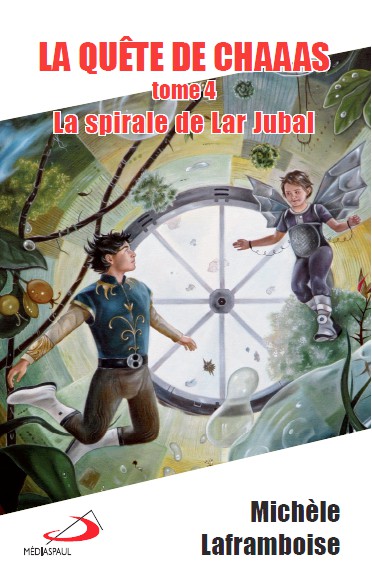
My next SF novel, La spirale de Lar Jubal, will be out in one month. (It will be printed in January to hit the book shops on February, just before the Outaouais Book Fair ( www.slo.qc.ca ).

Cover illustration of Chaaas 4 by Sybiline

On Lapsilis, a cylindrical habitat orbiting a devastated planet, young and old work hard to build a spiraling grain crop for their future world. If questor Sirius approves of this zeal which reduces the crime to almost nothing, Chaaas notices many people burning themselves out.

Then a strange disease is decimating harvests. Who would benefit from destroying the dream of Lar Jubal, the brilliant visionary lost too soon?
Lar Corom, a charismatic artist, tipped to succeed the debonair Ludrinn as the colony leader? Noalli, the embittered wife of Corom, overlooking the floating garden ? Ruffan, a fierce supporter of a return to the original purity of the Gardener’s  creation ? Or Lar Eimer, a haughty scientific  who doubts the merits of the project?

Chaaas must investigate without being distracted by the amber eyes of Lali kha Nakarli … and his warming friendship towards Corom. With the help of Kiumi, a girl acrobat, Chaaas will discover secrets that endanger more than the dream of Lar Jubal…

The novel is in French, and as it is coming soon.  If you can read a little French, the book will be available from  www.Prologue.ca or www.Amazon.ca websites. If you have read and liked the other novels of the Chaaas series, you may let it know, either by typing a review or rate it on Goodreads.com. If you hated it: do the same thing. There is no bad publicity… :^)

The full coordinates of the novel:

Michèle Laframboise, La spirale de Lar Jubal, Médiaspaul, (coll. Jeunesse-Plus no 16), 208 p.
ISBN 978-89420-852-6.

The cover art is from artist Sybiline.  For once, you get to see the protagonist close, and Chaaas is quite handsome!


Chasing your wild ideas!

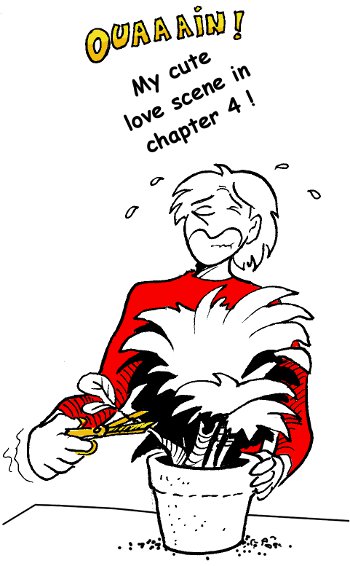
The science fiction author attempting to control the wild ideas for a novel!

There comes a point in writing where we feel that the story, the players and the universe that hold them have gained enough consistency to secure them in a tangible form. The ethereal cloud of infinite possibilities must now be condensed, into a brick (but not a too thick one!) Of course, there will always remain a small cloud of regret…

How to take this step without too much pain?

As I explained in another post, I do not have a rigid plan. I rather draw a grocery list. Here is one of the subplots in a novel work.  (It does not give the big punches, and if you can’t read French, my secret is safe, bwa-haha!)

Liste d'épicerie des intrigues secondaires d'un roman (elle s'allonge pendant la rédaction...)

I draw clouds of relationships between characters, and do the research to comfortably establish my imaginary world.

Nuages de relations pour le deuxième roman de la série Chaaas

An imaginary world well designed, whether in science fiction or in fantasy, do not only allows the author to return to it, but fans can also seize it (it happened with the universe Darkover by Marion Zimmer Bradley).

CAVEAT: Research is good, but … to some extent!

Trop de recherche nuit à la rédaction!

This is me writing a science fiction novel! Alas, too much “let’s google this, check up that” in the middle of writing the first draft of a manuscript will cut your swing, slow or even paralyze you. Oh, I wanted to read this post by Cory Doctorov sooner!

When you’ve worked and thought and lived with our stories behind the head, the characters grow and eventually become almost friends to the writer.

After the throes of planning is a very pleasant step in creating a novel. In my case, I enjoy doing lots of sketches that show a little life characters “outside” the scope of the novels. Here, I sketched a family scene from the world of Chaaas.

Le Bassin - croquis (et non, cette scène n'est pas décrite dans un de mes romans!)

The downside is that it might push the story in all  directions. And as it happens while I am writing, the manuscript gets longer! We must rein in those ideas, and jot down the wildest ones to recycle them for another story!

As the publishers have a specific format in mind for their books, there is usually a limit of pages to follow. We must strive to keep one or two main plot lines and give up many ideas and developments full of promises … with no guarantee that all the children of our imagination will emerge elsewhere!

Trimming down the manuscript can be tearful...

The secret well of ideas

The secret well of ideas !If there is one question that every published author hears at other events, it is this one : But where do you get all those ideas ?

Secret well of ideasMany people who dream of becoming a (famous) writer are scratching their head to find this mysterious well of ideas. Most are under the impression that writers form a tight circle around a secret lair of the golden-egg-laying hen. The secret well of inspiration, teeming with ideas!

This belief joins another one : all writers signing at the events are filthy rich!  Or if they are not, it must be because they don’t have access to a good well.

This in nonsense, as chance and fashion are the capricious ingredients that make or unmake successes. Also, many are convinced that once this idea has been fished out of the well, the main work is done, the book will write itself! Hence this ubiquitous anguished question : will someone steal my idea?

Relax, it is rather the opposite. Ideas are like dandelion seeds, easy to blow : pfffffuit!

Chaaas blowing dandelion seeds

They are blown in the sky half-formed, and many budding writers try to capture them with  clumsy fingers ! When they manage to catch one, they notice that there is still a long way  between the seed and the grown tree, between the idea and the completed book!

About ideas, the following scene happens often at a signing table (preferably when the writer is alone). A fan walks by, telling of his wonderful idea for a novel, an idea so genial that the writer should leave all his current projects to do the hard work on it! It happens especially with the SF writers…

An idea may be a very small seed at the beginning, so we must not try to pull from it a completed 600-page spy novel !

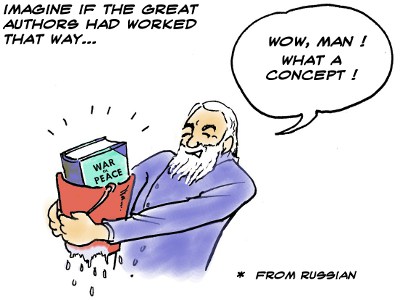
Imagine if the writers worked like that!

(Who is this author?)

Les Nuages de Phoenix (The Clouds of Phoenix) was my first SF novel aimed at YA. The novel idea took a long time to grow.

It began with a simple mental picture, a girl looking at the clouds. One of my favorites activities when I was a child. I happened to like meteorology (and I later followed climatology courses when studying Geography). The place took form, Phoenix is another planet with a green sky. Why green? Ah, enter the airborne particles size, and many other explorations.

In that special environment, I found out that the little girl, Blanche,  was handicapped, a consequence of a grave accident, and she wears an exosqueleton that gives her legs the capability of running at 80 km/h (a fun fact when I mention it in classrooms). New characters appear : Blanche has a family: an big sister in love , a father worrying about the oxygen production plant, etc.  Those characters grow and eventually become like friends of the writer. This is a very nice step in the creative process, and I will come back to it in a future blog entry.

Cover of Les nuages de Phoenix

The clouds of Phœnix‘s seed idea took about one year to grow discreetly, before I was ready to write the full-length manuscript. Afterwards, there has been the long rewriting and edition process under my editor’s eye. All in all, the novel took almost two years (working on it part-time) between the seed and the finished work.

I wrote about the challenge of growing a story in my French blog. A story begins as a tiny seed, which we put in soil and water, leaving it for a time. But the idea grows in silence. And nothing prohibits us to have more than one idea growing! Certain will get ripe earlier than the others.

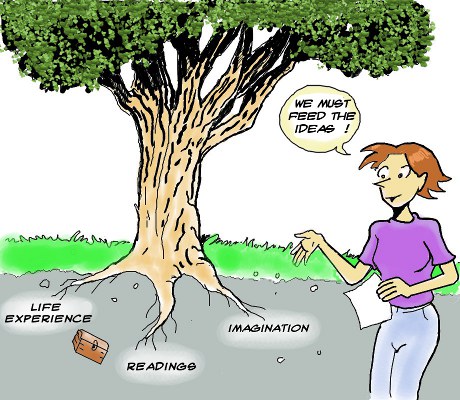
So, our inspiration tree must be fed, in three ways. We draw first from our own life experience, that help to get empathy with what our characters are living through. Then by our readings, any kind of reading: for researching our subject, for fun, for exploring different genres and ways of storytelling.. and last but not least, our imagination, always creating bridges.

The inspiration Tree

Many of those links may be absurd, but some will prove fecund.

A writer cannot get into an ivory tower and tell himself that his fertile imagination will be enough. Our plant needs watering, fertilizer, care: the three inspiration sources interact between themselves. And when the story gets too profuse, the care will later include pruning

(to be continued…)

Two new publications

Two new publications will be out for my birthday (July 14th) .  First, my Award-winning SF short-story  “Monarque des glaces” has been published in Solaris 175. The story depicts a dystopia set in an Earth reeling from a series of drastic climate and ecological changes.

The flower photo refers to Marguerite Andersen, the courageous editor of  the literary magazine Virages.  She does all the clerical work, despite the  recent cuts.

Marguerite is also the author of le figuier sur le toit , a precious personal account of life in Germany, in the pre-Nazi years. Germans were not a monolithic bloc, there were a diversity of opinions and political parties… until the elections of Hitler in 1933.

All this to proudly announce that another of my stories, “Château de neige”, will be published in the next Virages.

The silent destruction of creativity

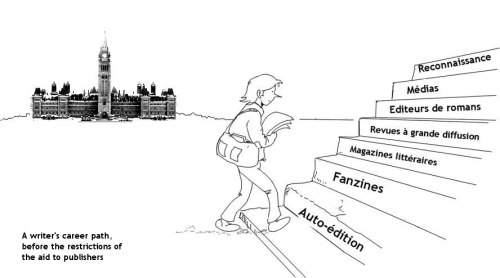
A writer's career path before the restrictions

The new Canada Periodical Fund (replacing the Publications Assistance Program/Canada Magazine Fund) will exclude any Canadian print magazines without 5000 copies sold per year.

It means that most of the French literary magazines that published my first efforts will be excluded! Among those,  Solaris, Virages and Ciel Variable, all running at less than 5000 copies a year.

I guess I can safely add the SF magazine On Spec to this list.

Although this number is aberrant for the French publication, who get the same minimum floor as the English ones, even if their readership is way less, (the ratio anglo/franco is  3 to 1. Meaning, a fair requirement would have been of 1250 copies for the pour the French magazines. (Thanks to Jean Pettigrew, publisher of Alire, and the magazines Alibis and Solaris, for this precision).

The same path, after the restrictions

This text (in French) on the Devoir website, by Jean Larose, explains the consequences of those new restrictions. After making away with the literary broadcasts and gutting Radio-Canada, for being “elitist” (that is a sin to educate people), it’s the turn of cultural magazines to taste the conservative medicine.

By transforming culture as a big-buck entertainment industry, by uniformizing the product, the government cut the next generation af writers and artists from a well of creativity, that precious resource helping humanity to cope with the challenges coming our way. And the more for Science-fiction. SF is a patchwork of ideas, thought-provoking scenarios, unlocking the reader’s imagination.

Author of Life of Pi, Yann Martel, explained how his literary career began with a small Vancouver fanzine who published his first efforts.  This humble publication pronged him to persevere in writing. He also appreciated his first writer’s grant, on the website http://www.whatisstephenharperreading.ca/about/ :

I, for example, represented 1991, the year I received a Canada Council B grant that allowed me to write my first novel. I was 27 years old and the money was manna from heaven. I made those $18,000 last a year and a half (and compared to the income tax I have paid since then, an exponential return on Canadian taxpayers’ investment, I assure you).

In the same way, Solaris and Ciel Variable, then Saisons littéraires and Virages published my first efforts.

In 1987, I had a poetry and a text published in number 2 and 5 of Ciel Variable. There, I met Hélène Monette, who also had her first poems published.  Now, more thant 20 years later, Hélène’s work, provocative, full of intellectual dynamite, was recognized by a GG award, (mine by a GG nomination the same year).

I take this occasion to thank warmly Solaris. In ten years, I passed through the entire cycle: a beginner, I received rejection letters. But those letters came with explications and commentaries that helped me to improve my writing. Solaris’ editors, Yves Meynard, then Joel Champetier, did that work, mostly on a volunteer basis.

Their advice led me to have nearly 10 novels published, six to eight literary Award and countless nominations (among them, the Trillium and GG awards) . The Jules-Verne Saga were a by product of a short-story initially refused by Solaris.

I would like to tell you that since those days, I have become a successful author with a large following of millions worldwide. That would be the only form of achievement that the Conservative government would respect, of course. Nevertheless, I am proud of writing my books and giving my lectures and workshops, dispensing encouragements to the young generation. The results are less tangible but, as with plants, they grow in silence.

I owe all this to the small publishers. If their -very modest – grants are cut, they will have more difficulties to survive. The  next generation of creators will be starved, denied the sunlight necessary for their growth. The competition will be fiercer for less publishing space, where official recognition will go to more popular and more vapid entertainers…  Overall creativity will suffer and dwindle, leaving less space for thinking. (see my other post there).

I leave the conclusion to Yann Martel, a citation from the same source

I was thinking that to have a bare-bones approach to arts funding, as the present Conservative government has, to think of the arts as mere entertainment to be indulged in after the serious business of life, that—in conjunction with retooling education so that it centres on the teaching of employable skills rather than the creating of thinking citizens—is to engineer souls that are post-historical, post-literate and pre-robotic; that is, blank souls wired to be unfulfilled and susceptible to conformism at its worst—intolerance and totalitarianism—because incapable of thinking for themselves and vowed to a life of frustrated serfdom at the service of the feudal lords of profit.


I won the 2010 Solaris Prize!

About one year ago, a Britannic webzine asked for short texts, one or three hundred words max, describing the future in one hundred years, and in the spirit of “mundane” SF. Mundane is a term coined by author Geoff Ryman to describe a “down-to-earth” approach to science-fiction stories.

I jotted a few ideas of a bleak future from which grew an embryo of text. I reworked it… and exceeded the word limit. So I left the text alone for a while.

One or two months later, I took the text back and managed to fold it into a story, with a bird-eye point of view by an unlikely character.

As the Solaris Prize deadline approached, I decided to work on it again, and polish it. The story finally grew strong and mature enough. So, like a child that I am proud of, I let it go…

And I received the good news last week. I’m a proud mother! The Prize includes a generous sum, plus the publication in the Solaris magazine.

The official communiqué (in French) is here

My first English SF workshop

Last Saturday, I took the bus and subway to go to a workshop.

The wookshop took place in the Tightrope books office, with a river of coffee with biscuits and strawberries. It was a very convivial setting, near a subway (excellent for me transiting from Mississauga).  Author and poet Sandra Kasturi was our host.

Sandra took the time to explore the preoccupations and favourite topics of each participant beforehand, so the workshop was well attuned. For me, it was my first English-language workshop (all my published books are in French), and I found out that I like to write in English!

Sandra’s sharing of her writing was deep felt. The writing exercises were short but intense, with the added incentive of submitting what we produced to various venues. Each of us, from first time writers to published ones, or hoping to, was well received. Francine is working on her novel, Johanne, an engineer like I was, is negotiating the hurdles of a first hard-SF novel , I had already read some of Kate Riedel’s texts in ON SPEC

I hope to see them again soon.

Sandra’s vision is that there shouldn’t be hard “rules” in writing, because each of us has a different lifestyle or occupation. She provided us with a lot of practical resource informations, plus a taste to continue to create and share our stories with the rest of the world.

Now, I must work on my flash-fiction…

My S-F novel is a finalist of the GG awards!

Couverture des vents de Tammerlan

Les vents de Tammerlan,  the second tome of my Chaaas’ cycle, is now a finalist of the General Governor’s literary Awards in the children’s literature category.

“This captivating novel by Michèle Laframboise strays from the well-worn paths of science fiction. While conserving the essential elements of the genre, the author’s subtle, at times poetic, prose creates moving and colourful images and gives life to complex, lovable characters.

It has been a long time since any science-fiction book, and proudly assumed, was nominated for those awards. The last was Temps perdu, (1984) and Temps Mort (1988), by Charles Monpetit. Meanwhile, children’s and young adults book collections flourished, and SF was relegated in the shadows.

It is a small victory for my story and my paper children, and a larger victory for science-fiction, now recognized as a full  flavour of the literary ice cream!