Category Archives: Science-fiction

“Have Ship, Will Travel” Launches today!

It’s not a play on the other quip Have gun, will travel, but this 400+ pages Have Ship, Will Travel anthology zooms into the space opera adventure stories your inner child covets.

The Space Opera Digest 2022, “Have Ship, Will Travel”, directed by Tracy Cooper-Posey, is published by Stories Rule Press. Stories Rule Press, in Alberta, Canada.

And with veteran writers like Kristine Kathryn Rusch and Douglas Smith heading the table of contents, you can be confident that you will pass a jolly good time on the routes of space! Of course, I do have a story featured in the Space Opera Digest 2022, that I hope you will enjoy as much as I did writing it.

So without much ado, here is the cover, and the link to get your electronic hands on the loot!

Are you craving a paper book, like this appetizing pic suggests? This anthology has a generous paper edition, and I know I will cherish my own copy!

https://books2read.com/HaveShipWillTravel

More info? Editor Tracy Cooper-Posey writes across several fiction genres, including space opera under two different pen names, and grew up reading classic science fiction.

Adventures among the stars need a ship to get you there.
Stories Rule Press presents Space Opera Digest 2022: Have Ship, Will Travel

Space Opera heroes and heroines explore the stars and discover cool new places in ships which range from beat-up rust-buckets to sleek technologically advanced craft that are the envy of the galaxy. Space ships are quintessential for the adventures and challenges our favourite characters face.

Come and explore over 400 pages of worlds of wonder and the ships our heroes fly with Stories Rule Press’ 2022 edition of Space Opera Digest.

Space Opera Digest 2022: Have Ship, Will Travel is the second volume in a quarterly collection of genre fiction anthologies presented by Stories Rule Press.

“Sole Survivor” by Kristine Kathryn Rusch
“Captain” by Stephen Sottong
“Big Top” by Sonia Orin Lyris
“Cycle Three” by Stephanie Mylchreest
“Star Cruise” by Ron Collins
“Watch of the Starsleepers” by Christopher D. Schmitz
“Tome Raiders” by Eric Del Carlo
“The Passenger” by Eve Morton
“An Ordinary World” by J. L. Royce
“Insanity is Infectious” by Cameron Cooper
“Achenar” by Jasmine Luck
“Moby Dick’s Doors” by Michèle Laframboise
“Learning Curve” by Neil Williams
“Exotic Matters” by Phil Giunta
“An icub on Mars” by Barbara G. Tarn
“Of Hedgehogs and Humans” by Rob Nisbet
“Smugglers Blues” by Blaze Ward
“Altered Skin” by Sara C. Walker
“An Unexpected Taste of Home” by Terry Mixon
“Symphony” by Douglas Smith

Space Opera Science Fiction Anthology
__

So, heed the call of adventure, and embark today !

A Story at the End of the Universe

True to the laws of thermodynamics, the expanding universe keeps cooling down. Now, the last transformed humans linger near the black hole at the center of our Galaxy.

The UnAttached, who count their age in billions of years, feed on the powerful X-ray emissions and rail against Entropy, that selfish cousin who sucks leftover energy. The Attached, recently forced to leave their ruined worlds, live too fast.

As the stars around them wink off one by one like in a dying city, what can they hope for ?

A short and crunchy hard-SF story set far, far in the future, told by multi-award winning author Michèle Laframboise, translated from the French by N. R. M. Roshak.

Accolades

The short-story published in Future SF had received several accolades:

“Cousin Entropy”… has a wonderfully Stapledonian scope. –Locus Magazine

“The hardcore physics fans out there will certainly enjoy this.” –Kat Day, for Tangent Online

“…a far-flung space opera reminiscent of Liu Cixin’s book.” –Alex Shvartsman, Future SF

“...a wonderful piece of Science Fiction, full of physics and feeling.” –Eamonn Murphy, SF Crow’s Nest (link underneath)

My inspiration for this story

My father Jacques- E. Laframboise had a fine telescope, and I recall many summer nights where he would adjust the position with patience, to point at this or that star, or planet. I still have the 1970’s astronomy books he had bought and, with another telescope, I search the skies, when said skies are not obscured by clouds or the luminous pollution of cities.

I always pondered the fate of our (pear-shaped) universe. The heat death of the universe linked to the ever-growing Entropy, does rarely make for an upbeat story, but add the transformed, long-lived remnants of humanity, and a pinch of spicy black energy, a tiny bit of humor, and voila!

I wrote the story in a short form, so it makes for a thin paperback, be warned. However, I allow my readers to share the paperback and give it to someone close, so you commpose your own chain of friendly atoms.

The translation had been done and edited by N. R. M. Roshak, to whom I owe a lot of gratitude. French is my first language, but a growing part of my public understands and read in English.*

Get your own End-of-the-Universe Story!

Fresh from my indie house Echofictions, Cousin Entropy has come out on several platforms. You can even order a paperback on Amazon.ca.

About the the nice cover image: it is a NASA/ESA pic taken by the Hubble Telescope, showing two colliding galaxies nicknamed The Mice, located 300 million light-years away in the constellation Coma Berenices.

* The French version, La cousine Entropie, is also available.

A Promise Kept – my First Story in Asimov’s!

After 16 years of besieging the English-language sci-fi magazines, a breach has been opened in Asimov’s wall. My sarcastic new “Shooting at Warner’s Bay” is out this month.

(Don’t look for my name on the cover, about 20 and 25 authors participate in each double issue!)

A promise kept

It is a special moment for me, because it was a promise I made to my father on his hospital bed, in November 2014. I had already started my cycles of submissions, but I had a lot less stories written at this time. Now with 120+ written texts, including 80 in the current submission cycle, I’m not short of ammo!

My dad Jacques E. Laframboise had a large library of science fiction and fantasy books (the Black Marabout collection). I read a lot of classic horror authors (Jean Ray, Claude Seignolle …), but science fiction was really more my thing. I had loved the Fin d’Ylla, a very, very old thing re-edited by Marabout. The Robots, by Isaac Asimov. A collection of translated short stories from Harlan Ellison.

Science fiction nourished my imagination, even if it had not made me popular with my French teachers, for whom there was one Literature with a capital L (generally written by long-dead, white Europeans guys) and the ‘paraliteratures’ like the detective, SF, fantastic novels that I read voraciously.

Of course, I would have preferred to get at this happy point earlier, so that my dad, and my grandma Edmée Laframboise (who loved to read detective stories) could rejoice with me. But, that’s life. And, at least, those stories will live on and find new readers.

Laying siege with perseverance

Table of submissions in October 2020 – almost 60 texts in the race at that time. Subs in French are now on a separate spreadsheet. Red: refjections. Yellow: active submissions. Green, acceptances. Blue: scheduled submissions.

Looking at that table, you can guess some mags answered faster than others.

The American pro SF mags pay very well, and they sit at the top of my mailing list for submitting a manuscript. Then, if the text is refused, I go to less prestigious magazines, then to semi-pro (which pay, but a little less) and finally to the “token” markets. To understand all these categories, I recommand the page of Ralan, who has devoted himself for 25 years to disentangling the “markets” (as named from the point of view of the author who is paid by the magazine).

SF pro magazines like Asimov’s receive several thousand texts per year. The acceptance ratio of pro mags being very low, that publication means more pressurized air inflating my pride balloon !

Climbing quality raises the acceptance bar

The overall quality of submitted texts always rises… and that’s good news for the readers!
Photo de Monstera sur Pexels.com

And as editor Scot Noel of DreamForge magazine pointed out, the average quality of the submitted stories is climbing, which makes it more difficult for the first readers to sort through the slush pile. The same phenomenon occurs for all other magazines as the level of writing increases. It is rather good news for the readers, but a challenge for a would-be writer. It is no longer enough for a story to be good, it has to shine, to stand out.

And, for me, I had to stop telling myself “I must write like X or Y” and to dive into my favorite flavor without feeling guilty for not writing in the genres in demand, especially with lots of deaths like horror or thrillers.

And I have to write with my heart, too, otherwise it would sound like a niah-niah-look-at-me exercise. That story in Asimov’s sprouted from my sympathy for ignored Hollywood actresses, and was fun to write. It flowed smoothly and didn’t require too many revisions or line edits.

By the way, why do I specify “my first story”? Because I am currently revising another short story, which will be released in 2022 in this same magazine. And I don’t miss any “ammunition” for other SF magazines!

Asimov’s, September-October 2021, double issue. For electronic subscription. Otherwise, run and buy it at the newsstand!

Building a House of Cards

My plotting process

Fragile as a house of cards

Any strong, researched plot I build looks as fragile as a house of cards in my mind. This is how I feel when writing a novel, a short-story, anything, in any genre including romance and science fiction.

And this happens to me even when I plan my stories in advance. The carefully-laid plan goes by the window after a certain point in the writing. And for my very first writing endeavour, I had bought into the “not writing a line before the plan is perfect” and followed by “show your work-in-progress to everyone (and get their advice)” to “rewrite ad nauseam until its polished and smooth.”

I found out that I am closer to a pulp writer than a once-every-ten-years literary author. So I write mostly by the seat of my skirt those days, going back if a nifty details grabs my attention.

My scientific self vs my story-telling self

And it doesn’t help that I am a SF writer who likes baking hard and crunchy SF stories. Sometimes I even overcooked them, making them so hard nobody could access its softer heart!

My scientific upbringing and formation in geography and engineering (even if I didn’t make a career in those fields) had left me with a reflex to check my premises and promise to my readers. I’m a nit-picker. I like flying off on the wings of pure fancy, but at a point my basic knowledge of sciences trips me.

Of course, I could stay in the fancy realm and ignore the science and call my story science-fantasy, where the ships engine screech like mad demons in the vaccuum of space.

Moreover, at any point in time, even the most concrete-hard SF story will be caught up by real science advances (e.g. lab-grown meat or gravity waves). The most I can do about a nagging detail is making a check in my paper books and on the web. If I have to research for more than one hour, without finding anything regarding this devilish detail, I leave it in the story.

Ta. Catch me if you can!

Melting chocolate fudge or rock-hard cocoa?

For me, some details are almost impossible to ignore. Like when you read a contemporary police procedural novel and your detective picks up various things around a body, with his bare hands! Unless it is set in a past era, everyone knows about prints, and now DNA! The same goes for your cat burglar who handles art items without gloves.

Some basics in science fiction are difficult to ignore, like the sound of ships in vacuum. I believe in making as much research as necessary for the story to hold together and not crumble, but if you are not a NASA rocket specialist, or a military strategist, it’s no biggie. Keep the very basic and improvise (ahem, build up) from there. I did read some hard-candied fiction by authors who have a professionnal background, but I do not expect to imitate them!

As one writer told me, you make your science as palatable as you like, whether soft, chocolate fudge that melts in the mouth, or hard 80% cocoa chocolate bar that defies the teeth! Telling stories should feel fun, not like dragging a chain and 100-kg ball behind oneself.

And you have all kind of readers from wide-eyed children to glazed adults, and the whole spectrum between. Some might prefer the melting in the mouth parts. The characters of the story will bear the weight of the plot, and the emotional/personal impact of the situation at hand (or at tentacle) will nab your reader.

Writing is not a straight line

Do I go back and change things? You bet!

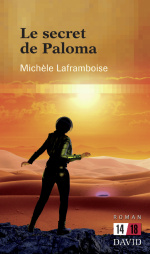
And generally, many of those details are about the characters interacting with their environment. I tend to follow the rule of three mentions, adding at least two instances of the details, so it sticks in the reader’s mind. For instance, in my novel Paloma’s Secret, one of the teenagers had a favorite and fun catchphrase, that I only found out about in the last chapters. So I went back and change the dialogue to add the catchphrase in the first chapters.

Do I write in order from word one and not stopping to the end? Nope. I have novels that begun with one impressive scene, plus the prequel and consequences woven out of the strong scene. Or a novel is a tiny seed that grows and grows.

Yes, my first efforts looked like a very convoluted garden hose.

As for my recent efforts at story-telling, you might get to see one very soon in the next issue of Asimov’s Science Fiction.

Reading Shock…

The reader, after finishing a good book, want's to thank the writer A.C. Crispin, but finds out she's gone.

I just finished “Sarek” an excellent SF novel by Ann. C. Crispin, set in the Star Trek universe.

In these trying times, I need some comfort readings, which I get from some Star Trek novels.

I just finished Sarek, (a story with Spock’s dad), a tale with finesse and a touch of Pon Farr that enriches the universe of the original series. (I ignored the ST reboot at the cinema). There, we meet Amanda in depth, and learn about her love affair with Sarek. The novel shows up this Vulcans are not walking cold computers, not perfect, but people with their own emotions, tradition clashes, preferences, disagreements. But they settle their difference in a more zen manner.

As with “Vulcan Heart” by Josepha Sherman (another fine writer we lost in 2012) and Susan Shwartz (many thanks to you!), this reading leaves me with a strong impression that our humanity, sick with conspirators, hate groups, anti-vaccines and anti-science, would need Vulcans (and also the Bene Gesserit, but that’s another universe). Just the basic control of emotions and the philosophy would prevent many problems from even happening (what’s the logic in despising dark-skinned persons?) in addition to cleaning up most prejudices.

The only flaw in this book, alas, is that we can no longer thank its author … Ann Carol Crispin left to count the stars in 2013. It’s a shock when it is a contemporaneous author who disappears.

Has the same thing happened to you? What was your most shocking experience? Please, share your testimony, because I haven’t found my zen state yet. So many writers to be grateful to, so little time!

Fortunately, Ann C. Crispin and the other departed writers have left many books behind, like a trail of excellent chocolate chips leading to the stars!

A Happy Bundle of YA Books!

StoryBundle was created by Jason Chen to give a platform for independent authors to showcase their work, and a source of quality titles for thirsty readers. StoryBundle works with authors to create bundles of ebooks that can be purchased by readers at their desired price.

Discover the YA MegaBundle!

All Books Large800

The YA MegaBundle organizer, Anthea Sharp, explains her motivation to link readers and writers with a super ebook deal. I met Andrea in 2016 and she is a talented musician as well as a writer. So I was delighted to be included in the Bundle with my YA SF novel Clouds of Phoenix!

A Word from the YA MegaBundle Curator

“I love connecting authors with one another, and with readers. This huge multi-genre project is a perfect chance to benefit a good cause (children’s literacy) and bring a little brightness into the world—for parents and teens alike—during this difficult time. Continue reading →

Brave new Worlds

BraveNewWorldsboxset

Worlds on the brink of apocalypse, or already there.
Nature’s wrath and dominion over humanity, and humanity’s folly incarnate.
Dark magic, terrifying tech, greed, ravaged environments, rare courage and grim hope in lost cities and fallen worlds.

Brave new worlds or last best hopes — Dare you glimpse the future?

Here Be Brave new Worlds – 13 SF & fantasy futuristic stories, novellas and novels, collected by U.K. author A. L. Butcher. I have read some stories by J.D. Brink, Rob Jeshonek and Leah Cutter previously, and their stories are a fine level.

My contribution is the dystopian story Ice Monarch. 

montage (1)


Come and get it, on the main platforms!


I fell down a rabbit hole… (The joy of researching)

2020MicheleMontreTard800

I did it again!

I am researching for a SF novel in preparation (the specifics I keep to myself for now) and, one interesting site after one fascinating site, found out that time compressed itself and most of the afternoon had fled down the rabbit hole!

I do not know if my scientific formation aggravates this time-sink habit. I hold a Master degree in geography, and so many aspect of macro-ecology do hold my interests!

Plus, even the very day-to-day concerns penetrates my Serious Writer mode.  From the over-usage of single-used plastics that keep turning up in the remotest places or the oceans, to the waste of my own pens and stylus, to the upcoming Great Backyard Bird Count, and my own, heart-warming geek love Valentine day short-story…

So, all those tiny bits cluttered like a planet aggregation process, dissolving my focus. Already 16h00?

As I mentioned previously, most of what I ‘m noting right now won’t ever make it to the novel you’ll read somewhere in the next year. Some of those, if I can’t place it in the novel, will turn up, greatly compressed, in one or two exploratory short-stories, set in the same universe.

What I will NOT do is integrating all that painstaking-ly gathered tidbits into the novel itself, under the form of some extra-large infodump, (or a rather lengthy explanation by a secondary character that will get killed in the next chapter).

Research as an iceberg

See research as the hidden part of the iceberg. What floats if what the reader experiences. If you tried to pull more of the iceberg over the water level, like I did in my first books (fortunately Daniel Sernine, my editor of the time, detected it) you would end up with an indigestible lump of details that weights down the storytelling.

Yes, I was one of those very interested in sharing all those cute details!

Yes it is soooo tempting to have your characters stop on a ridge and describe the wondrous landscape in excruciating details, over two or four pages! It is more palatable if the description is shorter, and punchy, like this one from a WIP:

The dunes went on and on, a pale sandbox barely contained by a row of angry mountains, each chipped and corroded summit vying for predominance.

Most of the research iceberg must stay invisible!

Solution is not dilution!

To keep our focus, it’s good to set limits, to avoid diluting our attention.

One solution in time management is to do the research after you complete writing a certain set number of words for the day. This is Kristine Kathryn Rusch’s method to limit the time spent in research. She also manage to get her research done before writing the novel, while she’s finishing the previous book.

Not the way of Dean Wesley Smith, who does his research as he writes, because some cool factoids will influence the story telling. I know it happened to a short-story I was researching for.

One obvious solution is to restrain the time passed on the social platforms. Or retire completely from social media in a period of rush. Julie E. Czerneda mentions it.

My own is setting a timer. Sometimes the amount of time is not enough and I prolong the time. Still work to do.

Or I use this experience to write a blog entry.


TL;DR : I lost time surfing the web for my research. Some remedies may apply


Flash news:

I had the joy of discovering that my last published SF story in Galaxies 60 (in French!)  is on the selection for the Grand Prix  de l’Imaginaire 2020.

Report on my Ad Astra 2019

The Ad Astra brings together fans and authors of science fiction & fantastic, both literary and mediatic in the north of Toronto. It’s a very user-friendly conference, which has left me with good memories.

Échofictions at the Ad Astra 2019

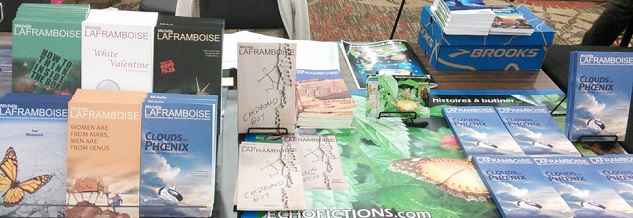
My house Échofictions had its vending table, which was successful. When people stop by themselves to look at the books and ask me questions, once in three, they leave with a book. Much better than my score at the big book fairs, where, on average, only 1 in 20 stop by my signing , because few readers come for the SF!

Michèle Laframboise devant son kiosque Échofictions

Michèle poses proudly in front of her stand, full of butterflies!

I launched the English version of my first SF novel, Clouds of Phoenix. Yes, the cover has changed, and the story has gained consistency. It’s the same story, but a little more detailed at 46,000 words! It is also the first full-length novel printed by Echofictions, whose full graphic design I realized.

2019-07-11CloudsPhoenix

Clouds of Phoenix, a novel by SF YA, 214 p.

Activities at Ad Astra

The nice surprises of the Ad Astra congress are the meetings with SF amateurs who did not know my books, and who discovered them. And to find fellow science fiction writers like Robert J. Sawyer, Julie Czerneda and Tania Huff presenting their latest Sf novels.

I have come to love this event; the sale tables are not expensive and the audience generous! I’ve offered a good choice of books translated into English.

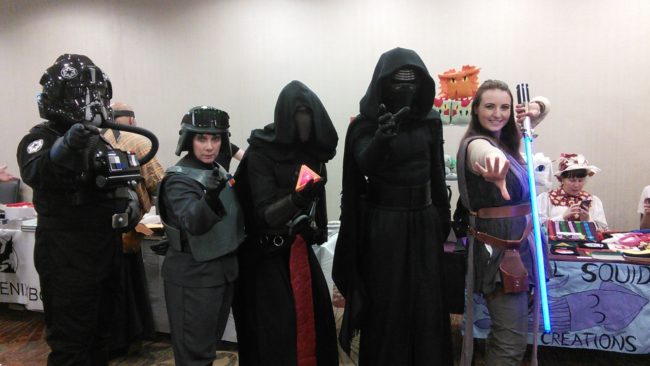
Un Cosplay typique du Ad Astra

A typical Cosplay. Don’t ya love’em! I admire the cosplayers’ time and effort to make their costumes. The craftswoman Squid Creations behind the band does not look too scared!

Table de bijoux artisanaux

A craft table.

Mon voisin de kiosque au Ad Astra Zachry Wheeler

My stand neighbor, an independent writer, Zachri Wheeler, very well organized! We exchanged books. Note the announcement of the film in development, it is always useful.

Douglas Smith

Douglas Smith (a Toronto-area author) reading an excerpt from his novel The Wolf at the End of the World. I had already bought his book Playing the Short Game, at another Ad Astra

2019-07-13 20.58.26 Allan Weiss Michele

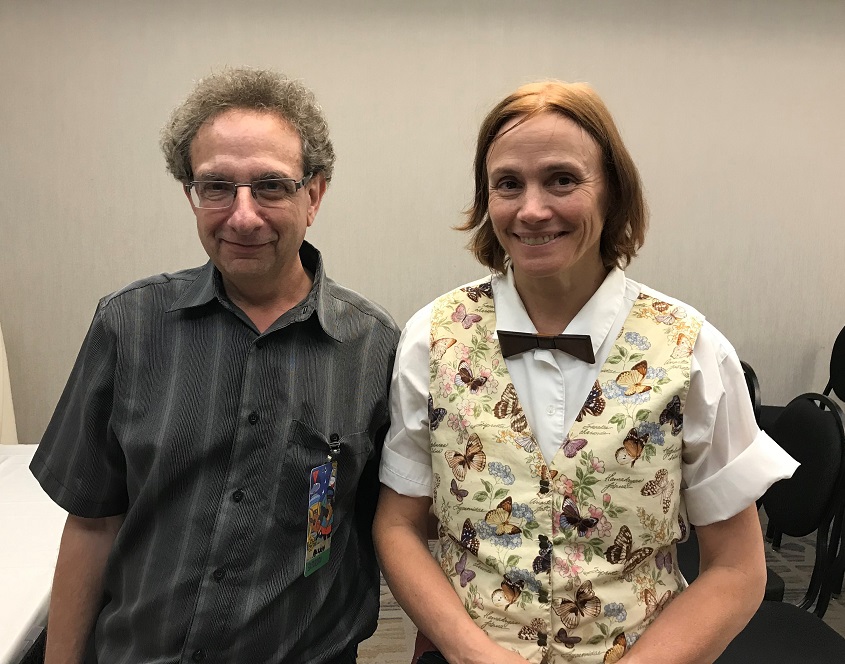
Allan Weiss and Michèle. It’s been 16 years that we know each other! Allan is a specialist and author of SF. Bow ties are cool!

Some Ad Astra panels I attended

My husband and son kept the table while I was there.

2019-07-13 18.29.43RomanPasCher
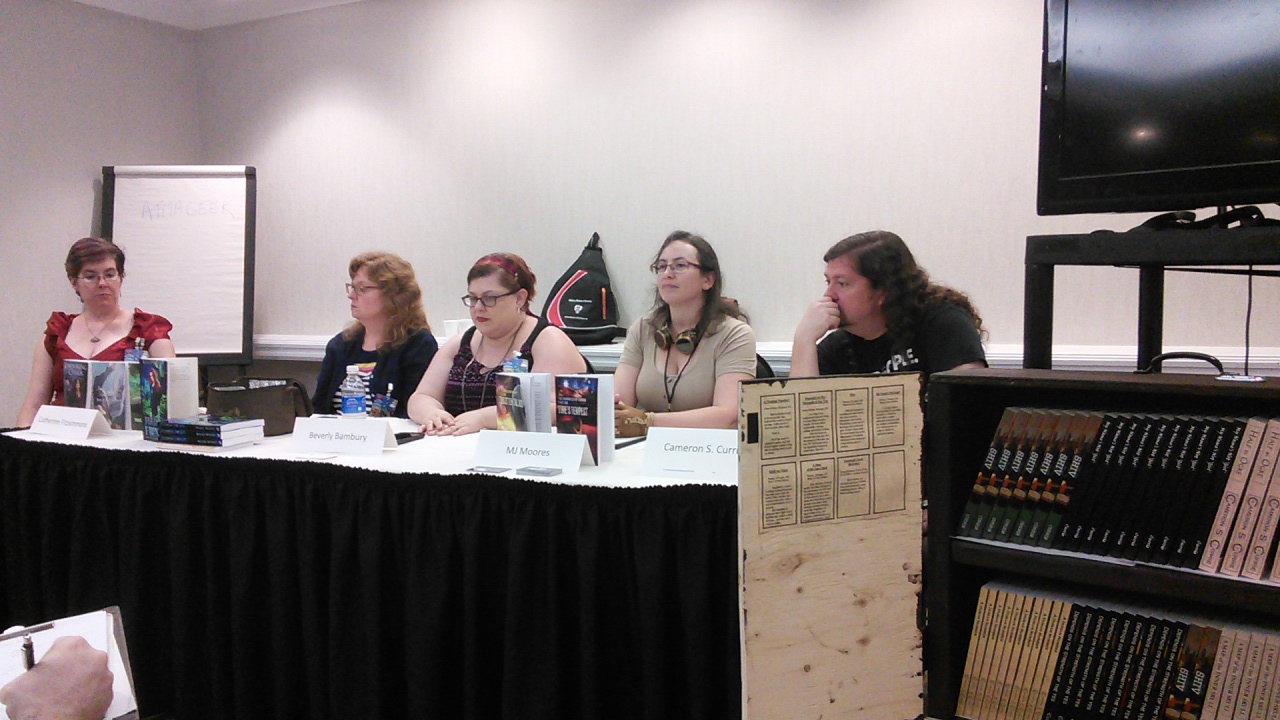
How to publish without spending too much!

How to publish for not too expensive, led by Beverly Bambury (center, black dress). The gentleman on the right, well organized, rolled his cupboard full of books!

2019-07-13 20.40.30AnimauxFantasy
The animals in fantasy with Avi Silver (left), Catherine Fitzsimmons and Eli Hirst. How to treat the Other, how to show the animal companions of heroes, or when animals are heroes.

2019-07-13MiddleAges
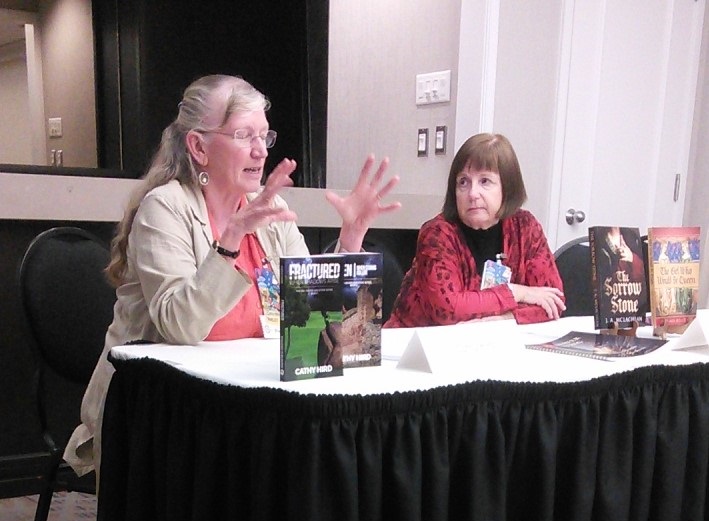
How to make medieval stories fantasy or historical. The mistakes to avoid! With Cathy Hird and L. A. MacLachean.

Book Harvest

Mon mari achète des livres au Ad Astra 2019

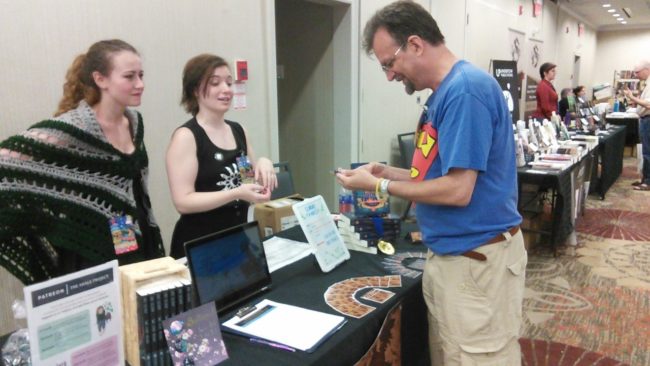
My husband buys books, a lot of books. He hides his secret identity well under his glasses…

Two Dark Moons

Two Dark Moons

For my current reading, I discover a new author Avi Silver, who considers himself non-binary.

In Two Dark Moons, we follow a teenager of the Hmuns who live in caves in the altitudes of the Eiji world, because the soil of the jungle is traversed by disturbing reptilian predators. Sohmen falls by accident (his fall broken by many branches). About 200 pages is very short, and enjoyable reading, in addition to staging non-gendered characters.

The Wolf at the End of the World

The Wolf at the End of the World

My colleague Douglas Smith signed his first novel to me, The Wolf at the End of the World, which mixes Native American legends and espionage, not to mention the nature threatened by greed on the part of the rich. Among us are Herokas, magic humans who can change into animals. Obviously, the secret services consider them as threats … But a too-hungry Wendigo and lost loves of the past mix the cards.

Canadian Dreadful

Canadian Dreadful, Anthology by David Tocher

Canadian Dreadful is a fantasy horror anthology inspired by the dark aspects of our beautiful big Canada. Edited by David Tocher, it brings together Canadian authors including Nancy Kilpatrick. I would not have bought it, but two public readings by participating authors convinced me to taste it!

I have not read yet the other books bought by my husband, a staunch supporter of new indie authors!

2019-07-13 AdAstraTable650

The things I learned from Ad Astra:

1- Novels sell better than short books and comics. Clouds of Phoenix was my best seller, almost half of my sales!

2- Participate in the round tables next year. It allows a first contact with the public, rather than “cold calling” behind a sales table.

3- Bring a tablecloth! It was not supplied, so I used a big poster to hide the uneven wood.

4- The month of July was not ideal, with less attendance due to vacations. Daniel, one of the organizers, said that the Ad Astra 2020 would come back in mid-April, at the same time as the Quebec book fair, oops!

5- If you missed the Ad Astra, know that … I will return next year, with new books. In the meantime, have a look at Echofictions’ list of publications!

Beat the heat with 10 refreshing books!

As the summer heat and Canada Day are upon us, most of you are looking for a place to spend your vacations… and for good science fiction adventure books to read!

So I look forward to dive into refreshing novels.

The choices are so much diverse than when I was a teenager looking for space adventures, and finding only guy’s adventures. I would say “white guy’s adventures” but in the 80s, male characters were on their way of getting more diverse, not so the female characters… (There were notable exceptions, and books from Ursula K. LeGuin that I  didn’t know existed at the time.)

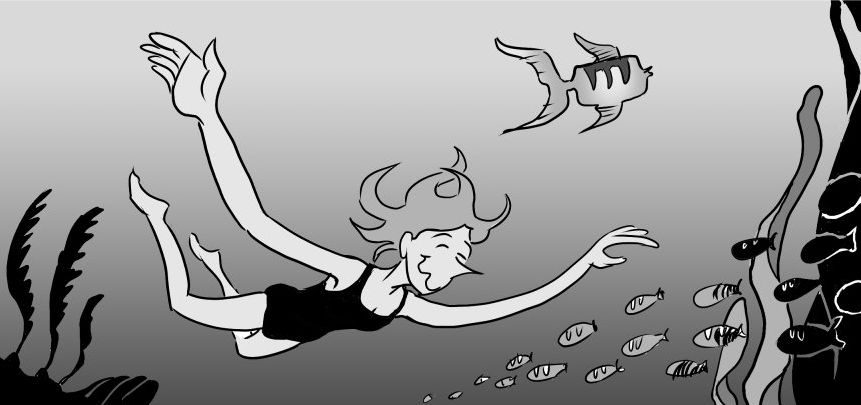
When I dip into the waters of an enthralling story (like The Calculating Stars, by Mary Robinette Kowal ) and explore its depths, forgetting all about the outside world. It feels like this:


Reading GoodBookShort

When you emerge from a powerful and moving story, gratitude floods you, along with a faint regret of having finished the book… but there are many other waiting!

And, speaking of good books…

SpaceTravelCovers1000

The Space Travelers StoryBundle reunites several wonderful writers, and I am proud to be a part of it with one novel (Clouds of Phoenix, featuring a disabled heroine on planet Phoenix) and one short-story (Closing the Big Bang) in the Space Travelers Anthology.

This StoryBundle is a joint promotion that gets 10 very affordable books in your hands, and helps you discover new writers along the way.

More details about how the Space Travelers StoryBundle works for you are explained in last week’s blog entry. The gist is: you pay what you want for the ebooks, and they will get into your reading device, whatever formatting you use. This helps the writers get new readers.

As for discovering new authors, I already knew Kristine Kathryn Rusch and Dean Wesley Smith, and they are entertaining and never dull. I discovered Robert J. Jeschonek, Lindsay Buroker and Leigh Saunders for their short-stories in anthologies.

However, I will discover Kristine Smith (I met her in 2006 at a convention) with this StoryBundle.

I can’t wait to dive into those new, exciting novels!