Tag Archives: Writing

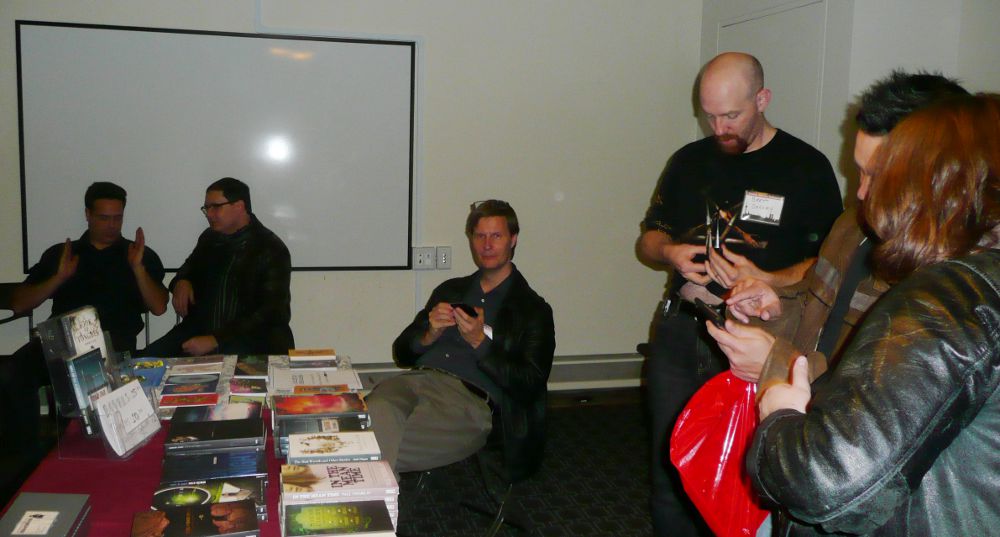
Random pics from the last Spec Fic colloquium

The format of the Toronto Spec Fic colloquium, (one day, one track of presentations, then one evening of readings) was perfect for my busy schedule. The setting was very Gothic, at the Hart House, in the center of Toronto.

Inner Court of the Hart house

There, I finally met Peter Watts. I read his fiction via Nimbus, a story he published in a Solaris (issue 143), then later came in contact with his online fiction, which prompted me to buy the books!
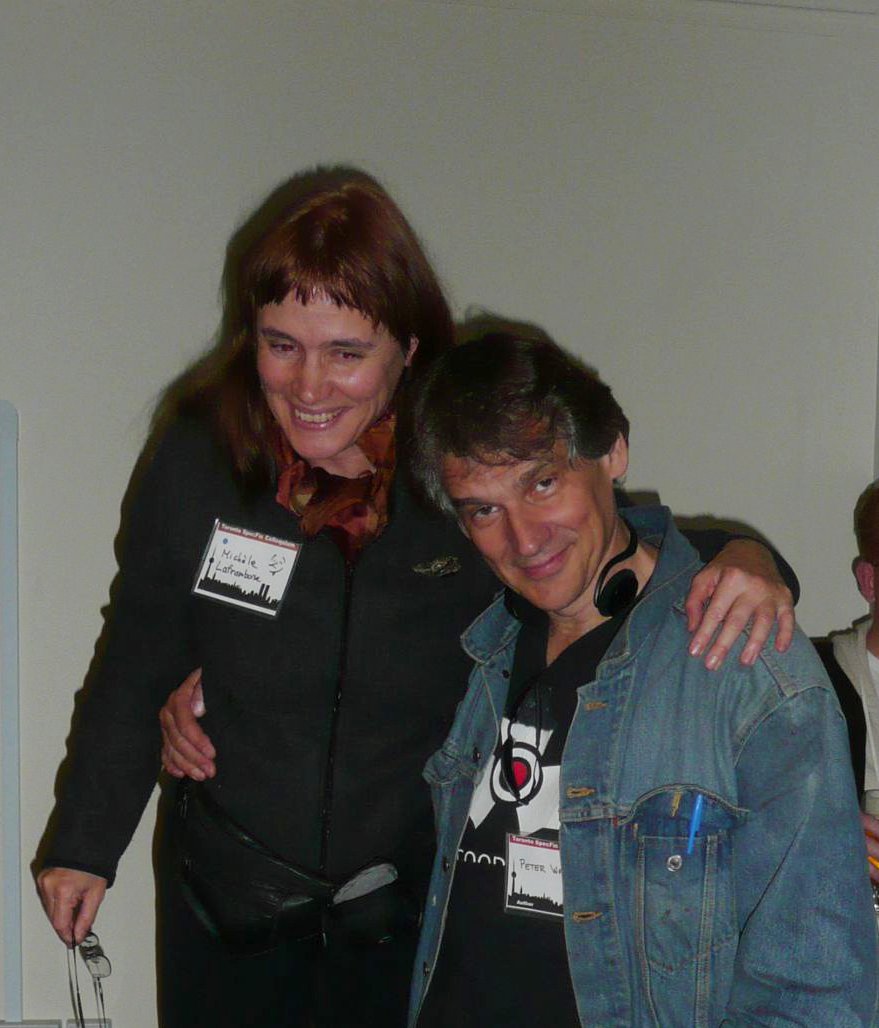
Sunday artist with Peter Watts

The Sunday artist meets Peter Watts.
Nooo, don’t look below!

Props!

I used a prop for the photo, but reaching his level of SF writing will take a lot more time and efforts! Peter Watts is a specialist in marine biology, and is not afraid to consult and do extensive research for his novels. And he is also a proud squid overlord! (The squid term now refer to us SF writers, from a rather disparaging comment made about Science Fiction by Margaret Atwood. And I was in the room in 2003 when she uttered a similar comment!)
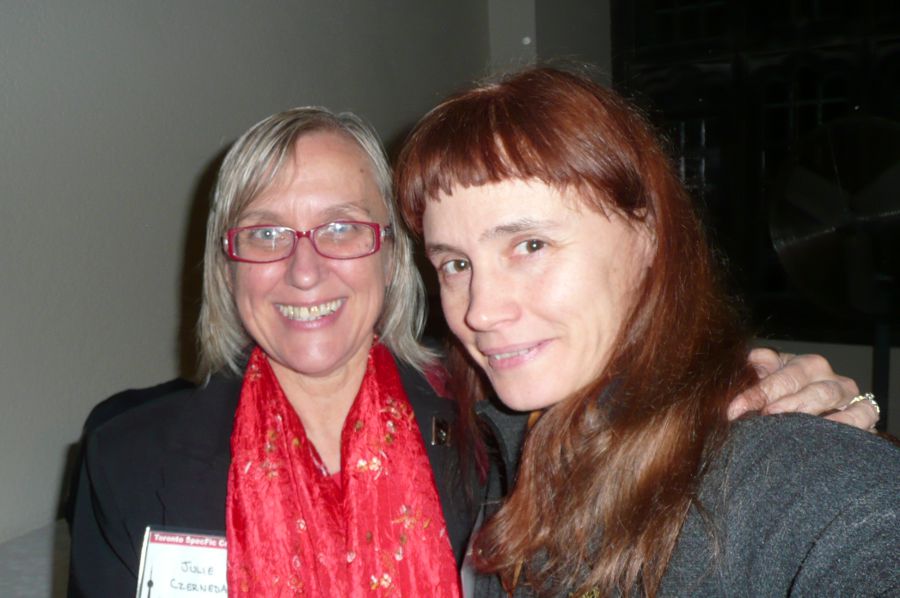
Julie Czerneda and Michele

Julie Czerneda, another Science-fiction writer who does not forget the science in Science-fiction. We look so nice from my arm’s length (and it did not need  climbing on a chair) !  I came back from the Spec Fic with her cool Trade Pact Universe trilogy.

Tony Burgess and Brett Savory at the Chizine table

Tony Burgess (He gave an ominous talk about raising young children while writing horrible things. We were treated to his recent horror novel trailer ) and to the right, Brett Savory, at the Chizine table. I also met David Nickle, whose dark fiction I discovered this year.
Karl Schroeder, Brett Savory and friends

Karl Schroeder with Brett Savory and friends.

Claude Lalumière gave a challenging speech, on when too much researching and science conformity can deter the creative sparks. Ahem. I myself tend to sink in the research for my SF novels… so as a budding writer, I was sensible to the arguments. But, as a former mad scientist, I like my science to be as up to date as possible in my novels

I bought his Object of Worship collection, and discovered a new and rich voice in the weird and fantastic. (More on my Goodread thread later!)

*

I took a few hours to walk at the Tightrope books office to assist to a very useful workshop on writing for children (and young adults), given by Marina Cohen. Her last novel, Ghost ride, is on the shortlist for the Red Maple Award given by the Ontario Library Association. She gave us tips on the craft, and also the business aspects of writing for a younger audience.

Tightrope Books office

Then, I walked back to the Hart House, on this fine autumn afternoon.

Election Boards

Or did I mention “on this fine municipal election day”?

Murale

A nice mural on the way.

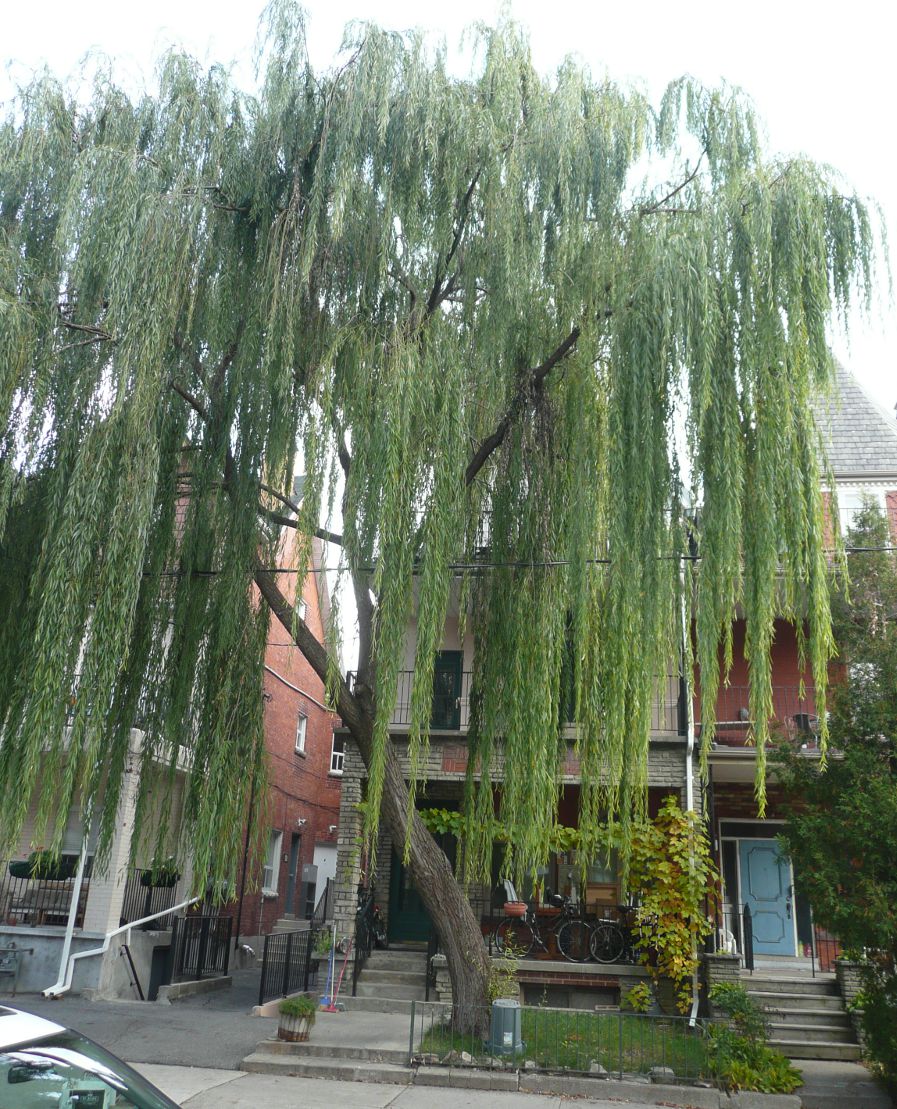
Weeping willow

A weeping willow…

cats in their vantage  look out

And cute cats in a window, yaay!! Spying on the passer-by…

The nice hostel where I took the dozen or books from the Spec Fic for the night (as the event lasted until around midnight)! I began reading Maelstrom, by Peter Watts, then Object of Worship.


Pembroke Hostel

The secret well of ideas

The secret well of ideas !If there is one question that every published author hears at other events, it is this one : But where do you get all those ideas ?

Secret well of ideasMany people who dream of becoming a (famous) writer are scratching their head to find this mysterious well of ideas. Most are under the impression that writers form a tight circle around a secret lair of the golden-egg-laying hen. The secret well of inspiration, teeming with ideas!

This belief joins another one : all writers signing at the events are filthy rich!  Or if they are not, it must be because they don’t have access to a good well.

This in nonsense, as chance and fashion are the capricious ingredients that make or unmake successes. Also, many are convinced that once this idea has been fished out of the well, the main work is done, the book will write itself! Hence this ubiquitous anguished question : will someone steal my idea?

Relax, it is rather the opposite. Ideas are like dandelion seeds, easy to blow : pfffffuit!

Chaaas blowing dandelion seeds

They are blown in the sky half-formed, and many budding writers try to capture them with  clumsy fingers ! When they manage to catch one, they notice that there is still a long way  between the seed and the grown tree, between the idea and the completed book!

About ideas, the following scene happens often at a signing table (preferably when the writer is alone). A fan walks by, telling of his wonderful idea for a novel, an idea so genial that the writer should leave all his current projects to do the hard work on it! It happens especially with the SF writers…

An idea may be a very small seed at the beginning, so we must not try to pull from it a completed 600-page spy novel !

Imagine if the writers worked like that!

(Who is this author?)

Les Nuages de Phoenix (The Clouds of Phoenix) was my first SF novel aimed at YA. The novel idea took a long time to grow.

It began with a simple mental picture, a girl looking at the clouds. One of my favorites activities when I was a child. I happened to like meteorology (and I later followed climatology courses when studying Geography). The place took form, Phoenix is another planet with a green sky. Why green? Ah, enter the airborne particles size, and many other explorations.

In that special environment, I found out that the little girl, Blanche,  was handicapped, a consequence of a grave accident, and she wears an exosqueleton that gives her legs the capability of running at 80 km/h (a fun fact when I mention it in classrooms). New characters appear : Blanche has a family: an big sister in love , a father worrying about the oxygen production plant, etc.  Those characters grow and eventually become like friends of the writer. This is a very nice step in the creative process, and I will come back to it in a future blog entry.

Cover of Les nuages de Phoenix

The clouds of Phœnix‘s seed idea took about one year to grow discreetly, before I was ready to write the full-length manuscript. Afterwards, there has been the long rewriting and edition process under my editor’s eye. All in all, the novel took almost two years (working on it part-time) between the seed and the finished work.

I wrote about the challenge of growing a story in my French blog. A story begins as a tiny seed, which we put in soil and water, leaving it for a time. But the idea grows in silence. And nothing prohibits us to have more than one idea growing! Certain will get ripe earlier than the others.

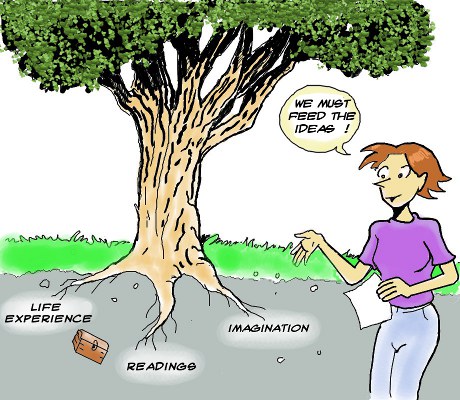
So, our inspiration tree must be fed, in three ways. We draw first from our own life experience, that help to get empathy with what our characters are living through. Then by our readings, any kind of reading: for researching our subject, for fun, for exploring different genres and ways of storytelling.. and last but not least, our imagination, always creating bridges.

The inspiration Tree

Many of those links may be absurd, but some will prove fecund.

A writer cannot get into an ivory tower and tell himself that his fertile imagination will be enough. Our plant needs watering, fertilizer, care: the three inspiration sources interact between themselves. And when the story gets too profuse, the care will later include pruning

(to be continued…)

The silent destruction of creativity

A writer's career path before the restrictions

The new Canada Periodical Fund (replacing the Publications Assistance Program/Canada Magazine Fund) will exclude any Canadian print magazines without 5000 copies sold per year.

It means that most of the French literary magazines that published my first efforts will be excluded! Among those,  Solaris, Virages and Ciel Variable, all running at less than 5000 copies a year.

I guess I can safely add the SF magazine On Spec to this list.

Although this number is aberrant for the French publication, who get the same minimum floor as the English ones, even if their readership is way less, (the ratio anglo/franco is  3 to 1. Meaning, a fair requirement would have been of 1250 copies for the pour the French magazines. (Thanks to Jean Pettigrew, publisher of Alire, and the magazines Alibis and Solaris, for this precision).

The same path, after the restrictions

This text (in French) on the Devoir website, by Jean Larose, explains the consequences of those new restrictions. After making away with the literary broadcasts and gutting Radio-Canada, for being “elitist” (that is a sin to educate people), it’s the turn of cultural magazines to taste the conservative medicine.

By transforming culture as a big-buck entertainment industry, by uniformizing the product, the government cut the next generation af writers and artists from a well of creativity, that precious resource helping humanity to cope with the challenges coming our way. And the more for Science-fiction. SF is a patchwork of ideas, thought-provoking scenarios, unlocking the reader’s imagination.

Author of Life of Pi, Yann Martel, explained how his literary career began with a small Vancouver fanzine who published his first efforts.  This humble publication pronged him to persevere in writing. He also appreciated his first writer’s grant, on the website http://www.whatisstephenharperreading.ca/about/ :

I, for example, represented 1991, the year I received a Canada Council B grant that allowed me to write my first novel. I was 27 years old and the money was manna from heaven. I made those $18,000 last a year and a half (and compared to the income tax I have paid since then, an exponential return on Canadian taxpayers’ investment, I assure you).

In the same way, Solaris and Ciel Variable, then Saisons littéraires and Virages published my first efforts.

In 1987, I had a poetry and a text published in number 2 and 5 of Ciel Variable. There, I met Hélène Monette, who also had her first poems published.  Now, more thant 20 years later, Hélène’s work, provocative, full of intellectual dynamite, was recognized by a GG award, (mine by a GG nomination the same year).

I take this occasion to thank warmly Solaris. In ten years, I passed through the entire cycle: a beginner, I received rejection letters. But those letters came with explications and commentaries that helped me to improve my writing. Solaris’ editors, Yves Meynard, then Joel Champetier, did that work, mostly on a volunteer basis.

Their advice led me to have nearly 10 novels published, six to eight literary Award and countless nominations (among them, the Trillium and GG awards) . The Jules-Verne Saga were a by product of a short-story initially refused by Solaris.

I would like to tell you that since those days, I have become a successful author with a large following of millions worldwide. That would be the only form of achievement that the Conservative government would respect, of course. Nevertheless, I am proud of writing my books and giving my lectures and workshops, dispensing encouragements to the young generation. The results are less tangible but, as with plants, they grow in silence.

I owe all this to the small publishers. If their -very modest – grants are cut, they will have more difficulties to survive. The  next generation of creators will be starved, denied the sunlight necessary for their growth. The competition will be fiercer for less publishing space, where official recognition will go to more popular and more vapid entertainers…  Overall creativity will suffer and dwindle, leaving less space for thinking. (see my other post there).

I leave the conclusion to Yann Martel, a citation from the same source

I was thinking that to have a bare-bones approach to arts funding, as the present Conservative government has, to think of the arts as mere entertainment to be indulged in after the serious business of life, that—in conjunction with retooling education so that it centres on the teaching of employable skills rather than the creating of thinking citizens—is to engineer souls that are post-historical, post-literate and pre-robotic; that is, blank souls wired to be unfulfilled and susceptible to conformism at its worst—intolerance and totalitarianism—because incapable of thinking for themselves and vowed to a life of frustrated serfdom at the service of the feudal lords of profit.


A worker-at-home’s move…

A useful remainder

I don’t know if you are a worker-at-home like me, but getting to answer to all the gas-marketers, electricity-marketers, after-life marketers… knocking at your door is time and energy-consuming.

Here is a nice thing I drew on a whiteboard with markers. I can enjoy tranquillity at last!

Now, to tackle those pesky telemarketers… and their elusive bosses!

My first English SF workshop

Last Saturday, I took the bus and subway to go to a workshop.

The wookshop took place in the Tightrope books office, with a river of coffee with biscuits and strawberries. It was a very convivial setting, near a subway (excellent for me transiting from Mississauga).  Author and poet Sandra Kasturi was our host.

Sandra took the time to explore the preoccupations and favourite topics of each participant beforehand, so the workshop was well attuned. For me, it was my first English-language workshop (all my published books are in French), and I found out that I like to write in English!

Sandra’s sharing of her writing was deep felt. The writing exercises were short but intense, with the added incentive of submitting what we produced to various venues. Each of us, from first time writers to published ones, or hoping to, was well received. Francine is working on her novel, Johanne, an engineer like I was, is negotiating the hurdles of a first hard-SF novel , I had already read some of Kate Riedel’s texts in ON SPEC

I hope to see them again soon.

Sandra’s vision is that there shouldn’t be hard “rules” in writing, because each of us has a different lifestyle or occupation. She provided us with a lot of practical resource informations, plus a taste to continue to create and share our stories with the rest of the world.

Now, I must work on my flash-fiction…

Views of Saskatoon in late Autumn

P1060589RiviereRochesPont The rocky side of the Saskatchewan River.

For the event Lire à tous vents, I had the joy to discover a Saskatchewan, visiting schools in Saskatoon and Prince-Albert. Prince-Albert was under snow, but I received a warm welcome from the staff and students.

The Saskatchewan River divides in two parts the Saskatoon city, founded in 1882.

Le bord de la riviere Saskatchewan Autumn reflection

Saskatoon had been named after the little Saskatoon bay which grew there. Seven bridges were built to reunite the two part.

Freshly disembarqued from the plane, I had a grand afternoon for visit the Mendel Museum with a nice mini-botanical garden, and the Art gallery.

PlantesP1060518 PlantesMuseeW

I was impressed by the portraits by James Henderson, realized between 1914 and 1930.

Henderson painted Indians, and was nicknamed  Wicite Owapi Wicasa: the man who paints the old men.

Galerie Mendel - portraits Portraits of chiefs with landscapes. Those faces are marked with dignity.

And, since for one I had the time, I took my tablet to copy some of the portraits.  The museums offered a lot of folding chairs for artist and art students. Here is on of my efforts.

DreamerW

(Guess which one from the murale…)

I visited 6 schools from threee different School boards who collaborated to make the event a success.  A few pictures of the visits, where I explain with caricatures the differences between the flavours of the literature ice cream, to introduce the students to science-fiction

P1060592 MicheleNarutoHKelseyWeb One Naruto in 30 seconds at Henry Kelsey school, Saskatoon

P1060563 TechnologieHolyCrossWebTechnologie salvatrice ! This smart board can keep the drawing in memory! (Holy Cross school, Prince-Albert, SK)

Séance impromptue de signatures après la présentations Signings at École Sister O’Brien (Ann Gordon O’Brien, social worker, helper of families and education)


The organizers made me discover the nice aspects of Saskatoon, among them, the Bessborough hotel.  Bessborough

With the Mendel museum, I found good restaurants, and never did I ate so well in a Tour! Among the new meals, The salade de poires et de fromage bleu, asperged with a vinaigrette aux Saskatoon berry, well balanced. Also, at my hotel Sheraton (near the “Bess”), The restaurant offered a lasagne au Ricotta et à la courge “Buttercup”. The dessert was, a Saskatoon berries pie.

Some hotels boast a nice interior garden, like this one.

Jardin Interieur


My S-F novel is a finalist of the GG awards!

Couverture des vents de Tammerlan

Les vents de Tammerlan,  the second tome of my Chaaas’ cycle, is now a finalist of the General Governor’s literary Awards in the children’s literature category.

“This captivating novel by Michèle Laframboise strays from the well-worn paths of science fiction. While conserving the essential elements of the genre, the author’s subtle, at times poetic, prose creates moving and colourful images and gives life to complex, lovable characters.

It has been a long time since any science-fiction book, and proudly assumed, was nominated for those awards. The last was Temps perdu, (1984) and Temps Mort (1988), by Charles Monpetit. Meanwhile, children’s and young adults book collections flourished, and SF was relegated in the shadows.

It is a small victory for my story and my paper children, and a larger victory for science-fiction, now recognized as a full  flavour of the literary ice cream!

Talking squids

Tsssk! Margaret Atwood doesn’t write Sf because she doesn’t write about “talking squids”. Her last novel, The Year of the flood, reviewed by UK LeGuin, is supposed to be Real Literature.  The Flood is good science-fiction, except  that you are not supposed to say it. High denial (S-F author is full denial stage)

My SF colleagues had a lot of fun trying to find something in their writing approaching this reduced definition of SF. I was certain I had coined in a story a funny-looking talking something, when… Ms Atwood changed her goalmark! Now, it must be a talking cabbage to pass muster as a real science-fiction writer.

Ursula K. Le Guin laments the passing of the squid on the Ansible : ‘[L]ast night on the Lehrer news hour Margaret Atwood did not say she did not write science fiction because she did not write about talking squids, but said that she did not write science fiction because she did not write about talking cabbages. I am pondering the significance of this change from sea beast to land vegetable, but so far it escapes me. She was otherwise charming, and I do think The Year of the Flood is good science fiction even though its cabbages are speechless.’ (23 September) Those eloquent cabbages presumably live on Planet X: the indefatigable Ms Atwood told the New York Times that her work is not sf since ‘I don’t write about Planet X, I write about where we are now.’ (21 September)

The ansible reports another funny thing concerning Cory Doctorow’s latest opus: Cory Doctorow has left our little genre behind, according to a review of his Makers subtitled ‘… a sci-fi writer growing up’: ‘It would be wrong to position this as a science fiction novel, even though it is set in the future and deals with technologies that do not yet exist …’ (Bill Thompson, New Humanist, September/October 2009)

The real reason is that the reviewer was enthralled with a good book, then the Pavlov reflex kicked in: (sing all together now): “If it is good, it can’t be science-fiction“.  Or the reverse: “If it is science-fiction, it can’t be good! ”

Ms Atwood’s book was ousted from the Booker’short list, by jury members who identified it (correctly) as SF, but were horrified by it. SF author Kim Stanley Robinson (of the Mars trilogy) asks why SF novels never wins the Booker Prize. Booker juries ignore SF submissions and give their awards to what usually turn out to be historical novels. He tells in his article, Science fiction: The stories of now: I say this as a happy fan and an awed colleague: the range, depth, intensity, wit and beauty of the science fiction being published in the UK these days is simply amazing.

Me, writing science-fiction? Naaah. I write real, grown-up, stern, serious, belly-gazing canadian literature! :^)

Never surrender

Around this time of the year, leaves begin to fall and my annual royalties come in. I opened the envelope on a rather nice day, to find an abysmally low number. This, after 15 years of continuing effort, 16 books and comic books, school appearances, hundreds of hours sitting at a round table in the bookfairs.

Meet my fans Meet some of my fans !

It might be the recession and low overall sales, but the impact of it left me staggering. My wonderful co scenarist and fellow author Alain Bergeron had just come ill, so I was floored. (By the way, Alain got better and left the intensive care unit last Friday. )

Until now, my writing have reap five Awards. La quête de Chaaas (Chaaas’ Quest)  has been recently nominated in two major general-lit awards. Bookstores commanded copies of the novel. My science-fiction book did not get any of those top awards. Bookstores returned the novels. (Those returned books were, of course, substracted from this year’s royalties).

When you appear as a writer in any event, many well-meaning people assume that you are  rich or at least, well-known.

In 2006, I met  at a panel several mid-career writers in the SF field. Most of those I considered “well known” like Nalo Hopkinson from Toronto, or outright celebrities, like Ursula K LeGuin. I felt at first as a pretender among  them, a beginner having at the time a few YA novels published, in French.

But then, as  I exchanged with them, I found out that every one of them were affected with dropping book sales, diminishing revenues, the advent of Internet… The mergers of big publishing houses managed by businessmen brought a “rationalization ” of the inprints.  Work of new ideas had no place in the commercial SF&F field.

When Ursula said “The book market has always been difficult”, I was  flabbergasted. Here was a luminary in the SF field, tellling us that for her, too, the times were difficult.

So, no, we are never “arrived at the top of the hill”. The social recognizance comes first and mostly from the $$$ an author makes, not from the quality and ideas. Even literary prizes don’t bring much fame if the book sales don’t soar.

Canadian SF author Matt Hugues, who has held many jobs over the years, including various menial jobs, but also speechwriter, put a very inspiring reflection on perseverance. His work was rejected time and time over thirty years, but always stayed on course. He was addressing budding writers.

A few years back, Matt gave the keynote speech to the Surrey Writers Conference:  No surrender!

Here is a short excerpt :

It doesn’t matter what they throw at us.

We are writers. We will not give up. We will not stay down. We will not say uncle.

We will get back up on our feet, we’ll look the world in the eye, and we’ll tell them, “No surrender.”

Thanks, Matt, for telling it.