(That post is for all those interested, wheter tyou are eligibile to vote for the Hugos or not. )
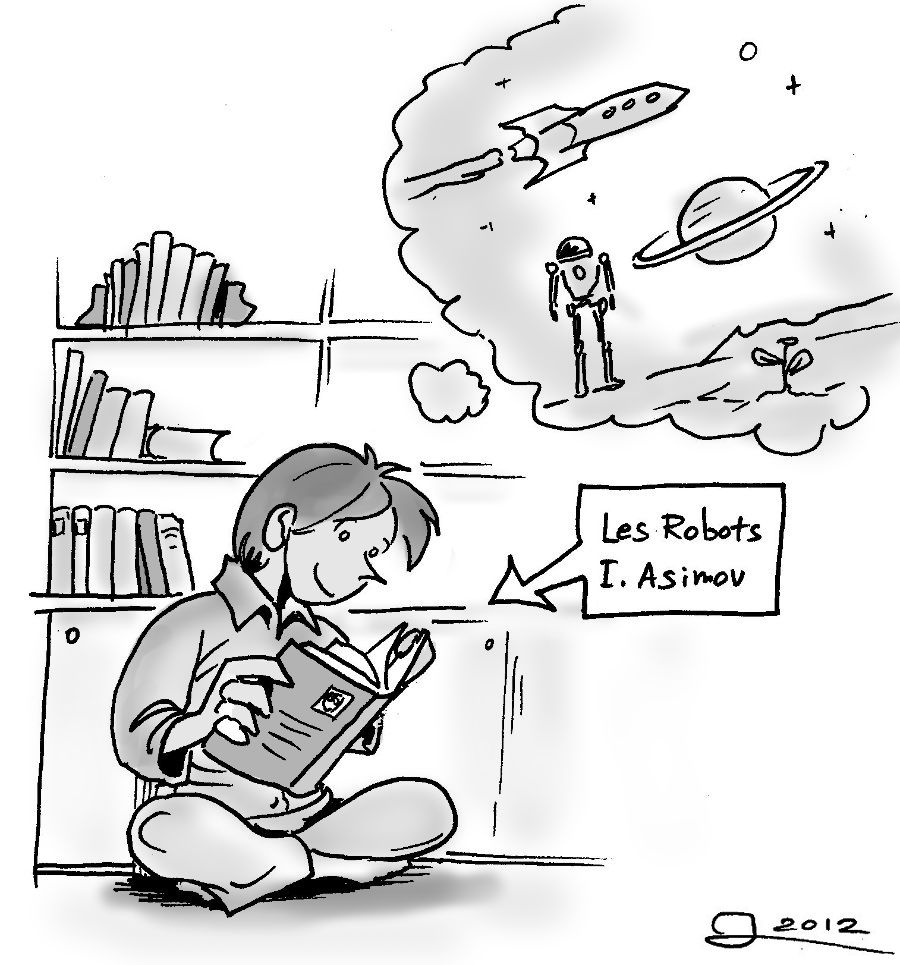
When my dear father Jacques E. Laframboise was very ill, in 2014, we talked a lot about Science fiction, of which he was a avid reader. We were discussing dirigible flight, for my steampunk universe. He was the one to introduce me to the genre, especially with the Asimovian robots. I had gone on to become a scientist then, later, a science-fiction writer.
So there at the hospital, I promised him two things: that one day, I would get published in Asimov’s magazine. Which happened in 2021. The second thing I promised my dad was that, one day, I would hold the Hugo rocket, as a winner.
This might be a far-fetched dream. First, there are many wonderful writers out there who craft deep, original universes and mind-bending plots. Second, winning an award it is less important than telling many good stories. Third, I already have several awards under my belt. But I am still thinking about that promise.
Maragi’s Secret is my first novella-length story published in Asimov’s SF magazine.
So, here are my 2024 publications, and some links to read them. The nomination deadline is March 15th, final voting at the Seattle Worldcon.
Maragi’s Secret, Asimov’s May-June 2024 – 20 000 words
CATEGORY : novella
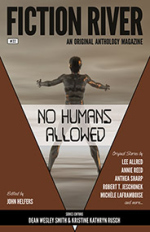
genre: SF steampunk (nothing to do with the big robot on the magazine’s cover!!!)
Short blurb: Maragi learns the ropes as a mast «monkey» aboard her father’s heavily-mortgaged airship, climbing its glacial hull six thousands meters over the poisoned Earth’s surface. She hopes to navigate the endless sky, humanity’s last refuge, but must face the scorn of crewmen who resent her presence. Little do they know the worse fate waiting a motherless girl in the straight-laced, rigid Cloud society.
Then, a fragile secret left by clandestine passengers forces a hard choice on her. Is saving it worth losing everything she cares about?
Michèle happily tapping away in a Montréal hostel in 2018
In January 2022, I gave a presentation in French about self-publishing, aimed at people either retired or close to retirement. All were interested in publishing their book and or memoirs. As I had started my own indie company Echofictions to make my published books and short-stories available, I could help them navigate the main hurdles on the way to get a book published, starting with the ISBN number.
Why writing a memoir is not a simple hobby
As history goes, most of what make up our daily lives vanishes quickly after our passing. The “big” history deals about big events (and wars, and colonisation) but this is not by far the whole fabric of our lives. And I am currently doing a research for an historical novel set in my own city, Mississauga, in 1979. Even if I remember that year, a lot of details get lost.
We are barely discovering through archival and legal papers, the everyday life of our ancestors. Some journals are unearthed. But even one or two generation spans can be difficult to recall. So this spurred me to call out, “write what you can about your parents, friends, and grandparents!”
Because you never know what will spark interest of the next generation, or the future historians!
You don’t need to wait !
I am currently writing a book of my mother’s memoirs. (After her passing last year, she won’t see the book, but she did enjoy getting her story published in the French lit magazine VIRAGES .)
After both my parents (and my grand parents’) passing, I measured how fast the funny anecdotes, the marking events dwindle in our memories. I had some anecdotes told to me by my paternal grandmother Laframboise, and at a point, I urged her to start a journal. She did, but did not complete it before passing. All I can tell is: she had a very beautiful writing hand.
So this is why, reader, whatever your age, please, write. One of the new authors attending my presentation was over 80. And one 77-year-old self-publisher told me, at a meeting in Oregon, that she did not aim for the glory, but to leave something for her grandchildren. It is a perfectly sound goal.
For myself, if my non-fiction reaches about 50-100 people in my extended family, I will be happy.
Nor do you need to sell a million books!
You don’t have to write like Stephen King or Barbara Kingsolver (my favorite author). Let the words pour from your heart, plunge deep in the well of memories of your parents, grand-parents, so the children coming after you can appreciate a little bit of life in our times.
None of us need to reach a billion readers, but your words will reach the people who matters to you.
And, for that activity, there is no mandatory retirement if it pleases you!
The When Words Collide convention in Calgary from August 16 to 18, provided a golden occasion to see old friends again and meet new writers and readers! It is an annual ReaderCon, meaning, focusing on books and reading more than movies and media SF.
Hanging out with friends
Yes, there are the presentations, lectures and workshops, but also, just meeting people from the four corners of the country and the US, people I haven’t seen since before the Covid, is a great moral booster. I met some of them in Montréal at the Scintillation 5 organized by Jo Walton and a dedicated team.
At home or visiting family, I rarely discuss my WIP, my projects (all the contrary in my teens).
I do mention the novels I’m working on, briefly, but expending about any challenge, lack of inspiration, difficulty would bring glazed eyes. But in a convention, interacting with peers who experience the same kind of problems give me courage.
Friends recharging their batteries in the central lobby of the Delta: Robert Runte (who knows a lot about Canadian SF) , Graeme Cameron, waving (who does a lot of work publishing Polar Borealis), Allan Weiss (Making Rounds) and a fine author I don’t have a name for.Michele with Susan Forrest (at the launch of Undaunted) on August 15thWith Brenda Carre, whom I met in 2016 at an Anthology workshop in Lincoln City. Brenda had a beautiful vest.Lyn Worthen and Michèle. Lyn writes dark fantasy and thrillers.
Books, books, books!
A host of new books covering the coffee table!
Adding to my pile of books:
Super Earth Mother, Guy Immega. Guy does hard-SF and takes his time to craft a believable story.
Drunk Slutty Elf and Zombies Den Waldron
Making Rounds, Allan Weiss
A crane among Wolves (just for the cover)
Undaunted, Dave Sweet with Susan Forrest
Skeletons in my closet, Dave Sweet with
War of the Words, a collection of short stories
Those I met but in passing, Rob J Sawyer, who in a presentation explained how the J in his name help people find him among the thousands of Robert Sawyer. Robert Runte, knowledgeable in Canadian SF.
Enjoy the Slush fiction!
I was deeply impressed by Rhonda Parrish, Adria Laycraft, Shirlee Smith, Ella Beaumont, Greame Cameron: super editors, able to detect a story’s faults and clichés. The panels of slush fiction I attended were fountains of fun (to put a bad cliché) and really instructive. Some pet peeves here:
Starting a story with a character waking up in bed
Having a POV character looking, observing… doing nothing.
Form the start, we need to know WHO is telling the story, or WHo we follow, and the story problem.
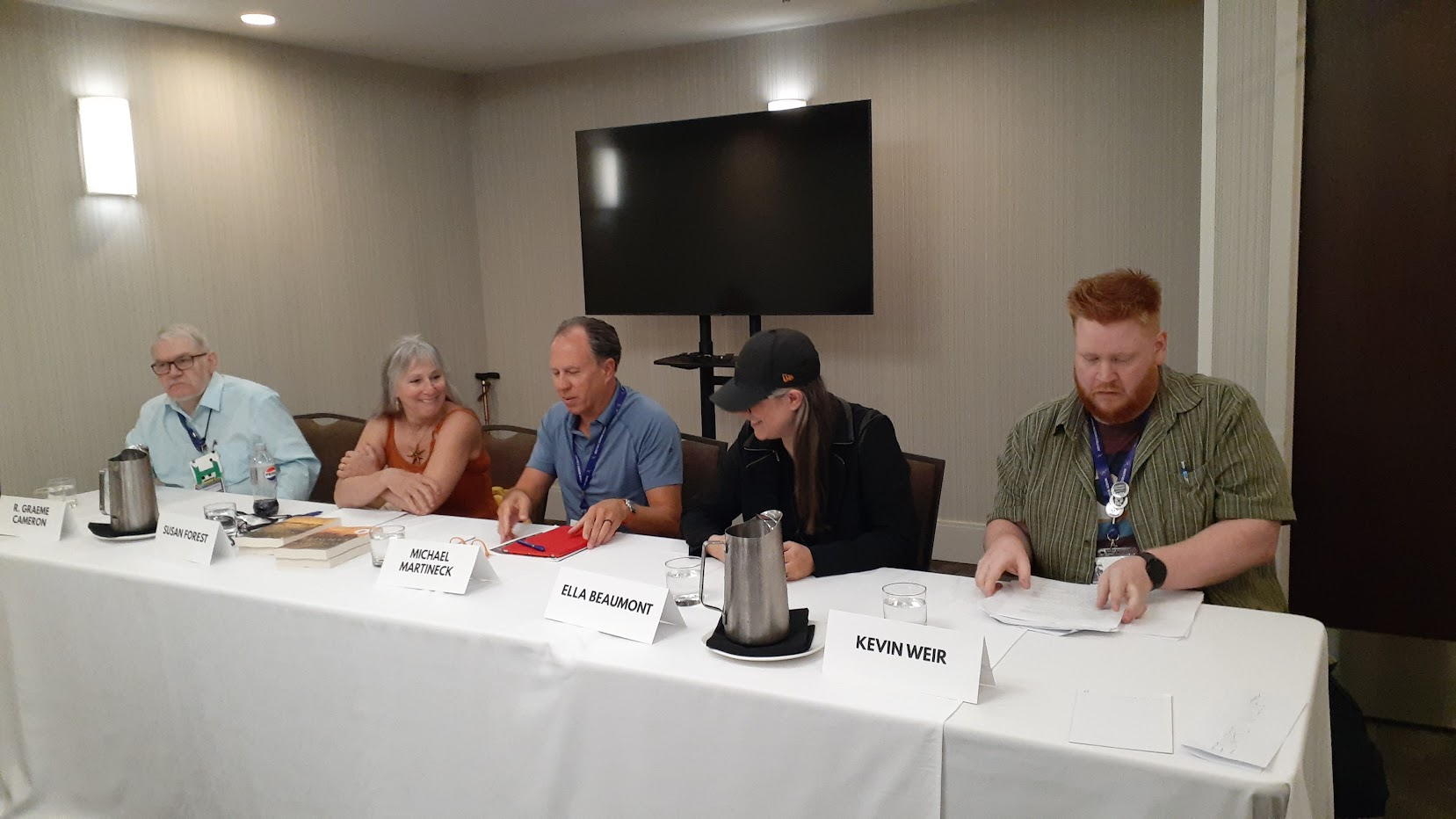
The Slush fiction panel with Left to right: Greame Cameron, Susan Forest, Michael Martinek, Ella Beaumont, Kevin Weir. Thank you!
Know your rights: contracts with Den Valdron
Den Waldron handing out a book to an audience member.
Den is a fantastic author of fun or gritty Sf books, but alse a lawyer, and here, he walks us through the pitfalls of copyright and contracts, those contracts that writers are soooo eager to sign to get published!
I never saw Den pleading in court, but as a presenter, he is lively as he walks around and tells it as it is. His booming voice still echoed in my ears as I write this.
Stop pushing us onto the sidelines!
One of the most useful panels about the presence of “disabled” persons in stories, and how they don’t want to be seen as a sidekick to the abled hero. A lot of good discussion. Left to right: Cait Gordon, Arlene F. Marks, Madona Sakoff, Rick Overwater and Fiona McTaggart.
Too often an author introduces a disabled secondary character into a story, mostly to check the disability box. BUT the treatment shows that often those writers have no idea what it’s like to live the experience. (I plead guilty here at least once, however, in Phoenix Clouds, Blanche is the heroine.)
My favorite panel, We are the heroes, not the sidekicks: Building worlds and stories in SFF that center disabled protagonists, with Cait Gordon, the author of this book, Iris and the Crew tear Through Space, and her colleagues: Arlene Marks, Madona Sakoff, Rick Overwater, Fiona McTaggart. Few people marginalized because of a disability recognize themselves in fiction.
“it’s just as infuriating when the person who looks like us is just a sidekick. Or, we “cure” the person’s disability and there, yahooo, everything is beautiful!” says Cait Gordon.
Or, the hero saves a pitiful disabled person but, oh the lottery winner! that person turns out to be the talented “whizkid” who will save the colony!
I learned a lot, and appreciated this inclusive vision. We need to stop ignoring persons who just have special needs for technical assistance and accommodation. In Cait Gordon’s universe, everything is accessible and no one considers themselves “disabled”.
One person noted: this is similar to the trap that many Paralympic athletes experience: pity or inspiration. Just for that panel and the friends I met there, the trip to Calgary (with the patient husband) was worth it.
Exploring around Calgary
After saying goodbyes to many new author friends, we went on a beautiful promenade at heritage Park.
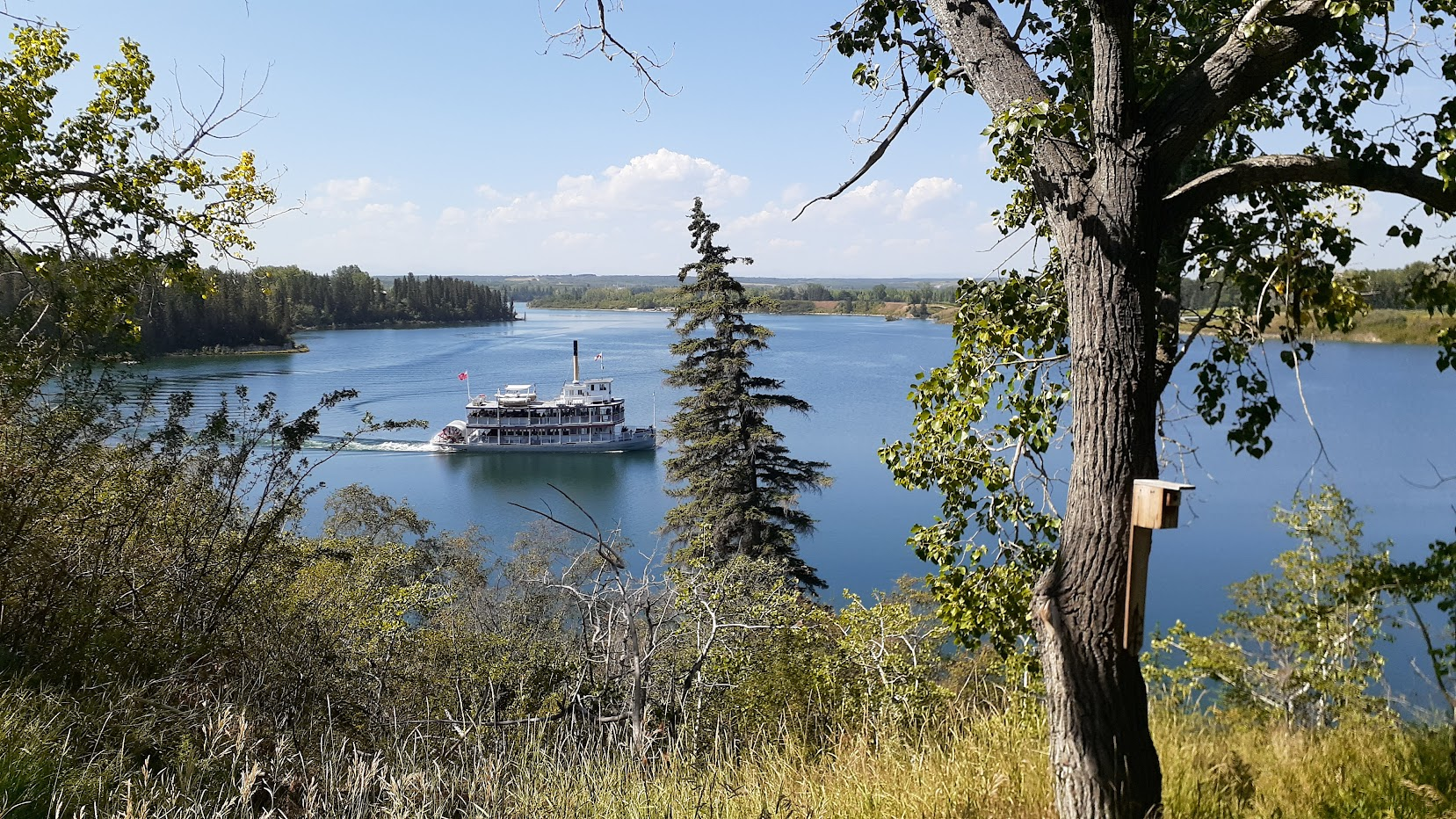
Lake near the Bow River, Heritage Park
After the convention, my husband and I walked in the Heritage Park, passing close the the Owl’s Nest Bookshop that was present at the Convention. The next day, we follwed the trails along the Bow River, to the Calgary downtown.
Analog Science Fiction & Facts has a blog where the editors interview the authors. This is my Q&A session for the latest story, “Living on the Trap”, published in the Nov-Dec 2023 issue of this SF magazine. And yes, I put on this picture, illustrating the perils of writing hard-SF !
I learned that my SF novel is a finalist in the prestigious Trillium Book Awards, an Ontario distinction. It is a very media-covered prize, so that brought a lot of distractions. My SF novel, Le secret de Paloma (Paloma’s Secret) is finalist in the children’s books category. As the three books are aimed at teenagers/YA, the name children’s book can be a misnomer.
The Trillium Book Awards are managed by Ontario Creates / Ontario Créatif.
It is good to get this nomination, my third for this Award, especially as almost all my YA novels are Science fiction stories. Getting regularly nominated means that my story-telling is improving, as it will, I hope, as long as I keep writing and drawing. It is also a sign that science fiction is getting more acceptance as a literary endeavor.
Science fiction is exploration of different worlds and scientific possibilities that eventually will impact our lives. Like the proliferation of AI in our technologies, a manifestation that I explored in a short-story published in Solaris magazine’s last issue (in French).
I think 2022 has been my best publishing year so far, with a new graphic novel and publications in Asimov’s and Analog. Go check the Echofictions website for more info.
I have been very involved in family affairs and caring fo my dear mother (who is well by now, fingers crossed) so I lacked free time to promote my works, and the Kickstarter fundraising for a special edition of my new graphic novel.
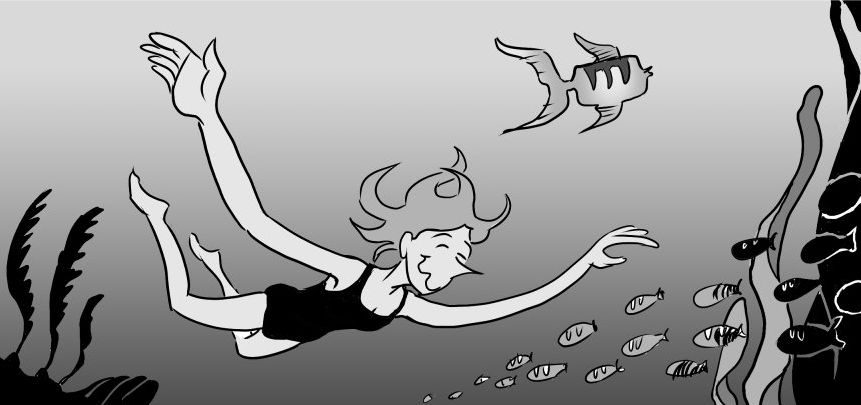
Some details missing like the scuba and palms, but you get how I feel when writing… or reading a good book!
Those who enjoy scuba diving (or who, like me as a kid, had watched Commander Cousteau’s documentaries) know that before going back to the surface, you have to make mandatory decompression stops to allow the molecules of nitrogen/ helium who had taken refuge in your tissus under high pressure to leave your body, via your exhaled air.
Otherwise, the nitrogen can decide to turn back into gas while it is still lodged in your veins and your cells, and it would not be a pretty sight. Decompression sickness is as dangerous as its opposite, the deep nitrogen narcosis which develops sneakily if you spend a too long time at 100 feet deep.
Diving in deep water
For me, writing feels like diving into deep water.
Except that my decompression breaks are in the opposite direction! It takes me a long time to reach the level of concentration deep enought to penetrate a story. Levels of ‘compression’ or concentration…
My first level takes about 45 minutes to an hour. I go over what I wrote the day before to get the story and its atmosphere back inside my head; I check notions, places, etc. If I write 100 words in that period, that’s normal.
At the second level, which takes me about an hour to reach, I am entering the story at 300-400 words per hour.
At the third level, everything becomes magical: my fingers hug the keyboard and the ideas are transmuted into words without my having to stop. I feel like the story is writing itself, and I’m approaching 600-800 words an hour.
If I keep this on without interruption, I reach my fourth level of concentration: the story tumbles like an avalanche in my head, fingers and words roll like marbles on a flat table. It is paradise. I smash through the 1000 words per hour wall. Often, this happens in the evening, when I have a deadline approaching.
BUT… I do not descend to this 4th level often.
Ah, if only my concentration levels were simple steps! (Photo by Francesco Ungaro on Pexels.com)
Interruptions!
On the other hand, to go up to the surface, there is no need for decompression stops. Any distraction can yank me up in a jiffy. The phone, someone calling me, or the family member.
As soon as my enthusiastic husband comes to tell me about a techno gadget he saw on the Internet or heard about on the radio, poof! immediate surfacing.
If the conversation is less than a minute or two, and if I don’t have to think to answer any complex questions, I can dive back in and get through my ‘focus’ levels pretty quickly.
Alas, this is rarely the case.
Another condition favors my rapid return to the depths: the certainty that I will NOT be disturbed again in the next few minutes!
So, after 5 or 10 minutes that ate my concentration. And, when the interruption ends, I have to dive back in and redo my stops. And, often, barely submerged, of course, it’s already supper time…
Confession of an unfocused writer
I created this article from a recent writing mishap.
Here I was, happily tapping on a wonderful science fiction story set in Antarctica, pom-pom-pom… when all of a sudden, a flawed scientific detail jumps out at me. Have I correctly calculated the position of the sun below the horizon during the southern polar night? Have I checked the right calendar for the current polar night?
Rising to the surface, opening the Internet, checking the info, then letting yourself drift on the Wikipedia sites, drift farther on the Scott-Amundsen station site, watching the web cam (it’s cold here, but not as cold as in the South Pole)… And, I came to my senses with the crucial realization of having wasted my time. It internally annoys me.
On the heels of that realization came another torment: should I change an explanatory paragraph to place it closer to the opening of the short-story? My words are so tightly knit together that moving one paragraph or one word requires rewriting several others, before and after. And so, I paddled on the surface to juggle these paragraphs.
Finally, after trying to dive back, I decided to go for a walk outside to clear my mind, and come back at another time. I told myself that it’s still warmer here (in Canada, Ontario) than at the South Pole…
TL;DR: Writing is like diving, but with the “concentration” stops going down instead of up.
Michèle Laframboise is a Canadian SF writer, with more than 60 stories published. Her most recent story, October’s Feast, is available in the Asimov’s SF Magazine. She is a fair low-level athlete runner, a lousy gardener, and avid birder. More on her official website here.
I was picking at the stubborn ice in the garage entrance. Again.
Clang!Clang!
My shovel made such a racket that I was certain the whole neighborhood had heard. At least, those neighbors who didn’t go out for work, which was, a lot of ’em this peculiar, cursed year. The current temperature danced around a balmy zero Celsius, but the wind had frozen everything hard.
If, at least, the Sun had spared some if its heat for the fissured blacktop of the entrance, the ice would have melted by itself. Alas, a bunch of gray clouds had been squatting the whole sky all day.
I hated it when winter couldn’t decide, once and for all, between staying over or under the freezing temperatures. One day, snow to our knees, the following day, it all melted into slush puddles; then the following night created uneven ice patches everywhere. Add the sidewalks to that equation, their broken slabs a danger for any walkers, hidden under the layer of pristine snow, and that’s southern Lake Ontario for you.
As my nice neighbors’ car entrance was a slippery incline, the risk of a bad concussion was multiplied tenfold. Hence me, hacking the ice like a mad woman, the metal reverberations grating my ears, the vibration stunning my wrists even if I wore padded mittens.
For now, the wind factor was chilling the sweat channel pouring over my spinal column. Swerving around the buildings, the wind surged from every direction, surprising me. I should have covered myself better than a sweater and padded vest, but too many layers only made me sweat more.
If only the darn winter could make up its mind! That dance around the zero was driving me nuts, besides wearing down the asphalt. And my patience…
At this hour, I should be cooking the no meat turkey, mashing the potatoes, finishing the chocolate cake that would only be a pale reflection of the one my grandmother made. And I had to set the table to greet the husband and son coming back from their own errands. And choose the best plates, those perched on the high-altitude cupboard shelf.
But the thought of my neighbor, not much older than I was but with her hip broken in a bad fall, prodded me on. Her husband’s sore back and weak heart prohibited him from any undue exertion, like shoveling dense snow. I was in good shape, relatively speaking, of course, so I toiled for them.
Of course, it was stupid of me to risk a heart attack to de-ice a car entrance.
***
Evening fell too fast, giving birth to a colored rivalry of Christmas lights, enhanced by technical prowess. I felt a pinch of envy regarding this prodigality, but those lights offered a gift of beauty to any passerby.
The world was so dark, so hard. Those constellations of blue, green and white lamps warmed up my soul. I paused, the echo of my last shovel hack sounding for long seconds. A fragile bubble of silence expended over the deserted street.
My breath created soft clouds of condensation that dissipated too fast.
The silence, in a city, was something to cherish. I listened for the chatter of chickadees, the angry twip of a house sparrow, the tiny crack of the hardened snow under the paws of a cat, or the light bounces of a scurrying rabbit.
But the only sound I heard was the dry crinkle of an envelope under my boot. Untouched, unopened, escaped from the recycling van with the complicity of the wind. On its face, printed Christmas ornaments and holly leaves, framing a too familiar message: give generously!
In my humble opinion, printing Give generously! or urgent!!! We need you! with an excess of exclamation points, constituted a strategical error. Most of those envelopes landed directly in the recycling basket.
I didn’t want to cast the first rock at my neighbors. But since charity organizations had taken to systematically share our address lists, it was twenty, thirty Give generously envelopes that fell in my mailbox, just because I, once, forgot to tick the microscopic square hidden in a small fonts paragraph.
This accrued pressure had caused a mild case of giving fatigue.
My thoughts turned darker. Yes, give generously, while tycoons and bankers fired men and women or conspired to shrink their worker’s rents, inflating their own wealth!
And those same ultra-rich would put one hand over their heart at charity galas, while the other slipped gifts in politicians’ pockets, garnered further tax breaks with legal tricks, accruing the burden for all others. (And then the politicians opened their hands and told the populace, “See, we do not have money…”)
Strangled by all those speculators, what would be left of this famous middle class that shrank and shrank? Donations dropped year after year, even with the added promise of an anonymous donator doubling or tripling the given amount. So many of us toiled at two or three jobs to make ends meet, conscious to be at one illness, one accident, one job loss from homelessness…
Clanggg! I hit the blue-brown ice with a vindictive zeal.
The shovel broke a layer of ice that would have felled my fragile neighbors. Smashing the ice was as difficult as weeding the garden. In summer, I struggled to unearth the deep roots of invading plants instead of just pulling the heads off. Battling the roots of corruption was as difficult; many politicians pulling off some scapegoat from their hat and going on as before.
Under the thin ice, another envelope winked at me. All red, with the same holly leaves and Christmas tree ornaments, but bearing a different message. Flash sale, Find your gifts here, 50% on everything…
The other face of the holidays, where stores and banks and insurance agents offered pre-approved credit cards with incredible rates… Those two injunctions fought for my mind space.
Buy, buy, buy!
Give, give, give!
Buy or give, but never disturb the generous speculators who congratulated themselves with champagne at Davos while pouring crocodile tears over the climatic crisis brought by their own profitable actions.
So be it.
***
This year, I had decided to forego the shopping and give all that I could: clothes, food, kitchen items, books to nourish the dreams…
A low drone rose.
I thought it was the car of a neighbor returning from a job that might evaporate next year, in another reorganization. Then I heard distant bells tingling under the loud clangs of my shovel. Under the tingling bells, a chorus of voices sang, soft like the abating wind. Were there still people singing carols?
For a moment, magic bathed my soul.
Then a familiar rumble of a diesel engine cut through the magical moment.
The beams of two spotlights swept the sidewalk that I was furiously hacking. I turned around, sweating and out of breath, my palms aching from the shocks, intent on spilling out my consumer/donator frustrations.
The chorus I had heard a moment before was flowing from the driver window of a huge eighteen-wheeler, pulling a semi-trailer. The trailer’s side was marked with an unfamiliar logo with holly leaves and one round tree ornament. Such a mastodon should never have been able to engage in our narrow, curved residential street! Neither should have it been able to ground to a halt without a loud hiss of brakes.
A ginger cookies scent titillated my nose, along with a waft of warm air from the open window. The left elbow of the driver jutted out, wrapped in candy-red, shiny coat.
A bearded face leaned out of the window, the lower edge encrusted with ice crystals that fell as his arm brushed over them. The soft singing was still pouring out, probably from a high-quality radio system, because the voices were so clean it sounded like an entire choir had been squeezed inside the truck’s cabin.
“Excuse me,” the driver said, “I’m kind of lost.”
His gravelly voice betrayed an age in the advanced seventies, confirmed by the beard, whitened by worries.
Another elder who had lost his pension and had been forced to work as long as he had some strength remaining.
No, it was his way that he had lost. And, as like most truckers, he was ‘on the clock’. I put my bad mood in my pocket, with the envelopes, and planted the shovel like a flag into a precarious snowbank.
“Where are you going?” I asked, my voice raspy with the cold.
The driver turned to cut his engines, gaining my silent approval. The rumble of diesel died out like an organ endnote. He scratched his head under the rim of his knitted cap. Red like the anorak.
“Well,” he said, “it’s a bit complicated, since my GPS has retired…”
“Retired? He’s luckier than I am!”
Oops! I had talked without thinking. The paper tip of my bad mood’s viper tongue peeked from my pocket.
“Sorry,” I said. “I’m a little like you, a freelance artist living day-to-day, so there’s no retirement package for me.”
“Oh,” he said.
He smiled, and that changed his physiognomy.
I mean, the guy didn’t have that perfect Colgate smile, whiter than white, over gums redder than his anorak. His teeth showed some wear and tear, toned to a soft ivory taint like an elephant’s defense. However, there was a light in his smile that rose to his eyes, their irises the pale blue of the ice, when free of impurities.
And this warmth, this light, evaporated the worries in my head, the magnates of this world receding into nothingness. I didn’t feel the cold sweat channel in my back, either.
It was at this moment that I noticed he had addressed me in my native French, despite my living in an overly English neighborhood in the Toronto area. How could he have guessed my proud Franco Ontarian culture?
“What brand is your GPS?” I asked. “A Garmin, a Tom-Tom?”
“It’s a Rudolph-2.”
“I’m not familiar with that brand.”
“Well, the first was the best, but since he retired…”
He had spoken on such a good-natured way that I almost didn’t notice the incongruity of a GPS going into retirement. I thought that poor trucker must have been so lonely on the long roads, that he spoke to his equipment. So, I asked him a good-natured question.
“And what are you transporting?”
His arm wove toward the back of the truck.
“Gifts,” he said.
As the single syllable left his fleshy lips, a warm scent of chocolate cake tickled my nose. I felt myself shrinking into a smaller me, transported in a familiar kitchen, as my grandmother was pulling from the oven a magnificent cake. Her mittened hands deposited the dessert on a pad on the countertop. Then she would spread her special cacao icing, a glory as each bite melted in the mouth, and place a little maraschino cherry at the center.
How I missed my grandmother!
I came back to the present with a start. If the bearded trucker carried food…
“Nothing perishable, I hope?”
“Oh, don’t worry, it will keep. I’m delivering everything this night.”
***
In certain stories or movies, there are moments when snotty critics qualified a character as genre blind.
For instance, you watch a movie with a bunch of teens in a haunted house, and the leader brilliantly decides, “let’s split up to cover more ground.” Of course, that was a staple of countless horror movies, like the young woman stuck in a mansion as Victorian as empty, who hears a noise coming from the cellar and goes down there to investigate the source, alone with her skimpy night robe…
That kind of genre-blind, of cognitive dissonance, was on me now. My brain had not connected all the dots yet, still rattled by the solicitation envelopes in my pocket.
So, I addressed the bearded man, hedging my bets.
“So, you’re a kind of Santa Claus,” I said.
I added my best ivory-toothed smile, the fruit of my privileged access to dental care.
At that moment, a concert of tweets and chirps rose in my back. Turning, I discovered a whole gallery of birds, the dream of any ornithologist doing the Christmas bird count.
Cardinals redder than red, with their more discrete dames, their plumage a beige and soft red. Cheerful black-headed chickadees, Black-eyed Juncos, with their best gray and white tuxedos, blue jays harping, and others that my eye couldn’t identify. Among them, a lone peregrine falcon perched on a branch, surprisingly indifferent to all those little meals chirping under its claws.
I was afraid that the truck would dematerialize like in the tales when I turned back.
But no, the driver was still there, one hand on the wheel, his kind eyes contemplating the bird assembly. Maybe I was mistaken, and it was St-Francis of Assisi hiding under this beard.
Really, I would be fine with that.
“Yes,” he admitted. “And I must deliver at a series of addresses.”
He foraged on the passenger seat and grabbed a pack of old matrix print paper. There must have been a hundred pages, all perforated on the sides. I glanced at the top address.
Not mine.
I felt a weird let down feeling. Then, I shook it off like snow from my boots. What was I griping for? Living in a fair neighborhood, in a country at peace?
A light bulb flickered in my mind: the first line was the address of a distribution center of food and clothes in my city. Because of the elite’s neglect or indifference, more families struggled to make ends meet, and donations were dropping. No wonder Santa Claus had changed his routes tonight.
Under the first address, I recognized others: a refuge for the street kids, a safe house for women and children in danger, a halfway house for ex-prisoners. I did not know the other places, but, flipping the accordion-linked pages, I could see area codes in Cyrillic characters, Chinese ideograms…
A gulf of gratitude filled me, warm as hot fudge poured from the pan. I clapped my hands in delight.
“Oh, I see what you’re doing, it’s, it’s fantastic! Thank you, thank you!”
He seemed happy from my reaction, and the birds tweeted louder.
“Yes,” he said, “and Mother Claus had even given me the locations of hidden political prisoners camps.”
That last bit saddened me. Long ago, I had sent a box of children’s shoes to an organism in Afghanistan. The box never got there. Lost in transit…
“The jailors will keep the gifts for themselves,” I said, my voice heavy.
That didn’t seem to bother him, no more than the time zones and Earth’s circumference.
“It will be a delicate affair, young girl, but for a guy who had slipped into millions of houses by chimneys or windows in a single night, no problemo!”
His young girl passed on me like a balm, because it was sincere. The good grandfather perceived me as the child I had been, as I was still inside.
However, there was just one little detail at odds with my ecological conscience. The gas-gurgling truck.
“Wouldn’t it be less polluting to drop your gifts from your sleigh, with the flying reindeers?”
There, he burst into a hearty laugh. Not the fabled ho-ho-ho, but a joyous wah-ha-ha-ha!
“A truck is less conspicuous. Especially with all those drones firing on everything, even the birds! As for the gas, the elves have produced a biofuel.”
He restarted the engine. I could smell a sharp scent of ginger coming out. He winked.
“Capiche?”
So, stepping on the foothold, I gave him the directions to get out of the street, and to reinitialize his GPS. His eyes perked up when the little red sleigh icon blinked on his screen. A powerful Ha! escaped in the night.
“I thank you, young girl. Do you want something in exchange?”
I considered the flock of birds happily hopping by, and breathed in the odor of grandma’s chocolate cake and ginger breads, all coming from the exhaust tubes.
One writer, on the verge of dying, had said that his most marvelous discovery had been to know that he already possessed everything he needed to be happy.
Me too.
A roof over my head, a family to cherish, a work I loved.
“You just gave me my gift,” I said, tears in my eyes. “I don’t need anything else.”
“Well, it has been a pleasure to talk with you. Embrace your loved ones for me.”
And, just like that, the gift truck rumbled on, leaving its good smell of ginger and chocolate behind. I followed it with my eyes until the taillights were gone.
***
I stood, unmoving, savoring the moment under the stars that shone without concurrence from the Moon. Then, the to-do list raised its ugly head in my mind.
Ice to break; meal to prepare; table to set.
My hand reached for the shovel’s handle.
And froze there.
Under my feet, the concrete slab was as dry as in July. The ice had evaporated on the sidewalk, so nobody would slip and get a hip fracture. On the street, and on the driveways near me, the black top had been regenerated, all cracks gone from its smooth finish. Nice of Santa, to think of the municipalities crushed under debts, putting back repairs.
Thank you, I thought.
You’re welcome, a voice answered in my head, just as a snowflake tickled my nose.
Snow was falling, big fluffy tufts, magical, as they only covered the lawns and gardens by now empty of birds. I put back the shovel inside our empty garage and headed for the front door.
As soon as I pushed it open, a flurry of good smells greeted me. Mashed potatoes, vegetables, tofu turkey with cranberries…
To my surprise, the table had been set.
With the best plates, those that usually waited on the high-altitude shelf, disposed on the clean fabric with their attending cutlery. It was as if a fairy—or Mother Claus?—had prepared this feast.
I was tempted to cry out You shouldn’t have done this!
But I didn’t.
Because, at that moment, I saw—and it drew tears from my eyes—what occupied the center of the table: a wide, generous china plate, the edge ornate with holly leaves (real, fresh ones) and small golden marbles.
And, on this round throne, a cake, worthy of my grandmother’s best art, covered with a thick layer of chocolate fudge icing, sending up a warm scent of cacao. On its top, a small round cherry sat, like a tiny Christmas ornament.
*The End*
May you all live and give in this Holiday Season !
(c) Michèle Laframboise 2021
Enjoyed this tale? At the time I actually wrote it, Serge Bouchard, a dear friend of all poets, who had been a trucker, had just left us. So the generous character in the truck would look a bit like him.
After 16 years of besieging the English-language sci-fi magazines, a breach has been opened in Asimov’s wall. My sarcastic new “Shooting at Warner’s Bay” is out this month.
(Don’t look for my name on the cover, about 20 and 25 authors participate in each double issue!)
A promise kept
It is a special moment for me, because it was a promise I made to my father on his hospital bed, in November 2014. I had already started my cycles of submissions, but I had a lot less stories written at this time. Now with 120+ written texts, including 80 in the current submission cycle, I’m not short of ammo!
My dad Jacques E. Laframboise had a large library of science fiction and fantasy books (the Black Marabout collection). I read a lot of classic horror authors (Jean Ray, Claude Seignolle …), but science fiction was really more my thing. I had loved the Fin d’Ylla, a very, very old thing re-edited by Marabout. The Robots, by Isaac Asimov. A collection of translated short stories from Harlan Ellison.
Science fiction nourished my imagination, even if it had not made me popular with my French teachers, for whom there was one Literature with a capital L (generally written by long-dead, white Europeans guys) and the ‘paraliteratures’ like the detective, SF, fantastic novels that I read voraciously.
Of course, I would have preferred to get at this happy point earlier, so that my dad, and my grandma Edmée Laframboise (who loved to read detective stories) could rejoice with me. But, that’s life. And, at least, those stories will live on and find new readers.
Laying siege with perseverance
Table of submissions in October 2020 – almost 60 texts in the race at that time. Subs in French are now on a separate spreadsheet. Red: refjections. Yellow: active submissions. Green, acceptances. Blue: scheduled submissions.
Looking at that table, you can guess some mags answered faster than others.
The American pro SF mags pay very well, and they sit at the top of my mailing list for submitting a manuscript. Then, if the text is refused, I go to less prestigious magazines, then to semi-pro (which pay, but a little less) and finally to the “token” markets. To understand all these categories, I recommand the page of Ralan, who has devoted himself for 25 years to disentangling the “markets” (as named from the point of view of the author who is paid by the magazine).
SF pro magazines like Asimov’s receive several thousand texts per year. The acceptance ratio of pro mags being very low, that publication means more pressurized air inflating my pride balloon !
Climbing quality raises the acceptance bar
The overall quality of submitted texts always rises… and that’s good news for the readers! Photo de Monstera sur Pexels.com
And as editor Scot Noel of DreamForge magazine pointed out, the average quality of the submitted stories is climbing, which makes it more difficult for the first readers to sort through the slush pile. The same phenomenon occurs for all other magazines as the level of writing increases. It is rather good news for the readers, but a challenge for a would-be writer. It is no longer enough for a story to be good, it has to shine, to stand out.
And, for me, I had to stop telling myself “I must write like X or Y” and to dive into my favorite flavor without feeling guilty for not writing in the genres in demand, especially with lots of deaths like horror or thrillers.
And I have to write with my heart, too, otherwise it would sound like a niah-niah-look-at-me exercise. That story in Asimov’s sprouted from my sympathy for ignored Hollywood actresses, and was fun to write. It flowed smoothly and didn’t require too many revisions or line edits.
By the way, why do I specify “my first story”? Because I am currently revising another short story, which will be released in 2022 in this same magazine. And I don’t miss any “ammunition” for other SF magazines!
Asimov’s, September-October 2021, double issue. For electronic subscription. Otherwise, run and buy it at the newsstand!
Any strong, researched plot I build looks as fragile as a house of cards in my mind. This is how I feel when writing a novel, a short-story, anything, in any genre including romance and science fiction.
And this happens to me even when I plan my stories in advance. The carefully-laid plan goes by the window after a certain point in the writing. And for my very first writing endeavour, I had bought into the “not writing a line before the plan is perfect” and followed by “show your work-in-progress to everyone (and get their advice)” to “rewrite ad nauseam until its polished and smooth.”
I found out that I am closer to a pulp writer than a once-every-ten-years literary author. So I write mostly by the seat of my skirt those days, going back if a nifty details grabs my attention.
My scientific self vs my story-telling self
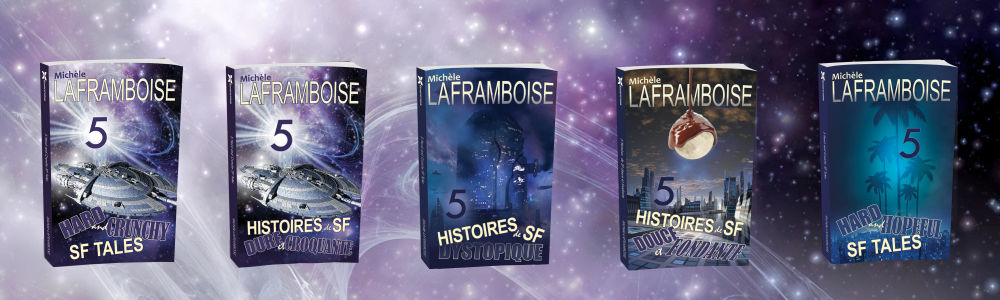
And it doesn’t help that I am a SF writer who likes baking hard and crunchy SF stories. Sometimes I even overcooked them, making them so hard nobody could access its softer heart!
My scientific upbringing and formation in geography and engineering (even if I didn’t make a career in those fields) had left me with a reflex to check my premises and promise to my readers. I’m a nit-picker. I like flying off on the wings of pure fancy, but at a point my basic knowledge of sciences trips me.
Of course, I could stay in the fancy realm and ignore the science and call my story science-fantasy, where the ships engine screech like mad demons in the vaccuum of space.
Moreover, at any point in time, even the most concrete-hard SF story will be caught up by real science advances (e.g. lab-grown meat or gravity waves). The most I can do about a nagging detail is making a check in my paper books and on the web. If I have to research for more than one hour, without finding anything regarding this devilish detail, I leave it in the story.
Ta. Catch me if you can!
Melting chocolate fudge or rock-hard cocoa?
For me, some details are almost impossible to ignore. Like when you read a contemporary police procedural novel and your detective picks up various things around a body, with his bare hands! Unless it is set in a past era, everyone knows about prints, and now DNA! The same goes for your cat burglar who handles art items without gloves.
Some basics in science fiction are difficult to ignore, like the sound of ships in vacuum. I believe in making as much research as necessary for the story to hold together and not crumble, but if you are not a NASA rocket specialist, or a military strategist, it’s no biggie. Keep the very basic and improvise (ahem, build up) from there. I did read some hard-candied fiction by authors who have a professionnal background, but I do not expect to imitate them!
As one writer told me, you make your science as palatable as you like, whether soft, chocolate fudge that melts in the mouth, or hard 80% cocoa chocolate bar that defies the teeth! Telling stories should feel fun, not like dragging a chain and 100-kg ball behind oneself.
And you have all kind of readers from wide-eyed children to glazed adults, and the whole spectrum between. Some might prefer the melting in the mouth parts. The characters of the story will bear the weight of the plot, and the emotional/personal impact of the situation at hand (or at tentacle) will nab your reader.
Writing is not a straight line
Do I go back and change things? You bet!
And generally, many of those details are about the characters interacting with their environment. I tend to follow the rule of three mentions, adding at least two instances of the details, so it sticks in the reader’s mind. For instance, in my novel Paloma’s Secret, one of the teenagers had a favorite and fun catchphrase, that I only found out about in the last chapters. So I went back and change the dialogue to add the catchphrase in the first chapters.
Do I write in order from word one and not stopping to the end? Nope. I have novels that begun with one impressive scene, plus the prequel and consequences woven out of the strong scene. Or a novel is a tiny seed that grows and grows.
















 Echoes of a Sunday artist
