Tag Archives: Secret well of ideas

Chasing your wild ideas!

The science fiction author attempting to control the wild ideas for a novel!

There comes a point in writing where we feel that the story, the players and the universe that hold them have gained enough consistency to secure them in a tangible form. The ethereal cloud of infinite possibilities must now be condensed, into a brick (but not a too thick one!) Of course, there will always remain a small cloud of regret…

How to take this step without too much pain?

As I explained in another post, I do not have a rigid plan. I rather draw a grocery list. Here is one of the subplots in a novel work.  (It does not give the big punches, and if you can’t read French, my secret is safe, bwa-haha!)

Liste d'épicerie des intrigues secondaires d'un roman (elle s'allonge pendant la rédaction...)

I draw clouds of relationships between characters, and do the research to comfortably establish my imaginary world.

Nuages de relations pour le deuxième roman de la série Chaaas

An imaginary world well designed, whether in science fiction or in fantasy, do not only allows the author to return to it, but fans can also seize it (it happened with the universe Darkover by Marion Zimmer Bradley).

CAVEAT: Research is good, but … to some extent!

Trop de recherche nuit à la rédaction!

This is me writing a science fiction novel! Alas, too much “let’s google this, check up that” in the middle of writing the first draft of a manuscript will cut your swing, slow or even paralyze you. Oh, I wanted to read this post by Cory Doctorov sooner!

When you’ve worked and thought and lived with our stories behind the head, the characters grow and eventually become almost friends to the writer.

After the throes of planning is a very pleasant step in creating a novel. In my case, I enjoy doing lots of sketches that show a little life characters “outside” the scope of the novels. Here, I sketched a family scene from the world of Chaaas.

Le Bassin - croquis (et non, cette scène n'est pas décrite dans un de mes romans!)

The downside is that it might push the story in all  directions. And as it happens while I am writing, the manuscript gets longer! We must rein in those ideas, and jot down the wildest ones to recycle them for another story!

As the publishers have a specific format in mind for their books, there is usually a limit of pages to follow. We must strive to keep one or two main plot lines and give up many ideas and developments full of promises … with no guarantee that all the children of our imagination will emerge elsewhere!
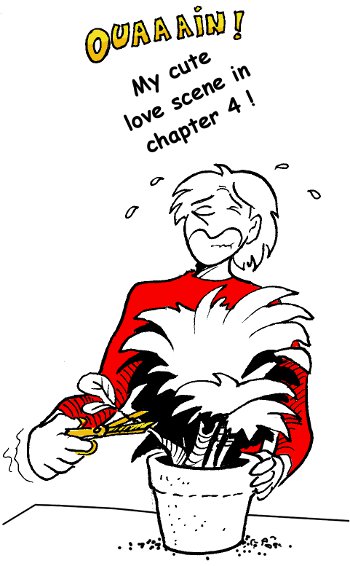
Trimming down the manuscript can be tearful...

The secret well of ideas

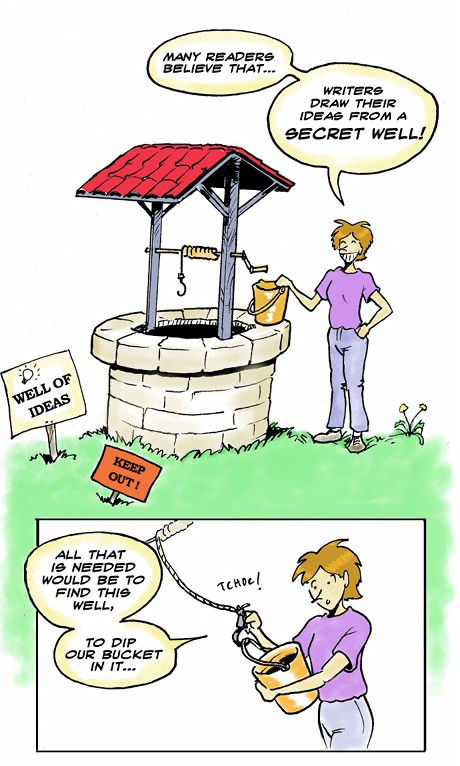
The secret well of ideas !If there is one question that every published author hears at other events, it is this one : But where do you get all those ideas ?

Secret well of ideasMany people who dream of becoming a (famous) writer are scratching their head to find this mysterious well of ideas. Most are under the impression that writers form a tight circle around a secret lair of the golden-egg-laying hen. The secret well of inspiration, teeming with ideas!

This belief joins another one : all writers signing at the events are filthy rich!  Or if they are not, it must be because they don’t have access to a good well.

This in nonsense, as chance and fashion are the capricious ingredients that make or unmake successes. Also, many are convinced that once this idea has been fished out of the well, the main work is done, the book will write itself! Hence this ubiquitous anguished question : will someone steal my idea?

Relax, it is rather the opposite. Ideas are like dandelion seeds, easy to blow : pfffffuit!

Chaaas blowing dandelion seeds

They are blown in the sky half-formed, and many budding writers try to capture them with  clumsy fingers ! When they manage to catch one, they notice that there is still a long way  between the seed and the grown tree, between the idea and the completed book!

About ideas, the following scene happens often at a signing table (preferably when the writer is alone). A fan walks by, telling of his wonderful idea for a novel, an idea so genial that the writer should leave all his current projects to do the hard work on it! It happens especially with the SF writers…

An idea may be a very small seed at the beginning, so we must not try to pull from it a completed 600-page spy novel !

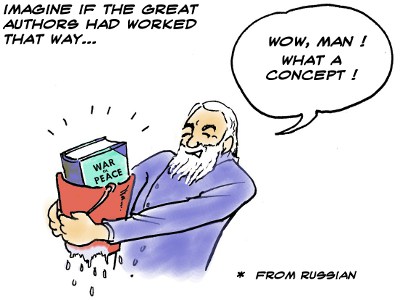
Imagine if the writers worked like that!

(Who is this author?)

Les Nuages de Phoenix (The Clouds of Phoenix) was my first SF novel aimed at YA. The novel idea took a long time to grow.

It began with a simple mental picture, a girl looking at the clouds. One of my favorites activities when I was a child. I happened to like meteorology (and I later followed climatology courses when studying Geography). The place took form, Phoenix is another planet with a green sky. Why green? Ah, enter the airborne particles size, and many other explorations.

In that special environment, I found out that the little girl, Blanche,  was handicapped, a consequence of a grave accident, and she wears an exosqueleton that gives her legs the capability of running at 80 km/h (a fun fact when I mention it in classrooms). New characters appear : Blanche has a family: an big sister in love , a father worrying about the oxygen production plant, etc.  Those characters grow and eventually become like friends of the writer. This is a very nice step in the creative process, and I will come back to it in a future blog entry.

Cover of Les nuages de Phoenix

The clouds of Phœnix‘s seed idea took about one year to grow discreetly, before I was ready to write the full-length manuscript. Afterwards, there has been the long rewriting and edition process under my editor’s eye. All in all, the novel took almost two years (working on it part-time) between the seed and the finished work.

I wrote about the challenge of growing a story in my French blog. A story begins as a tiny seed, which we put in soil and water, leaving it for a time. But the idea grows in silence. And nothing prohibits us to have more than one idea growing! Certain will get ripe earlier than the others.

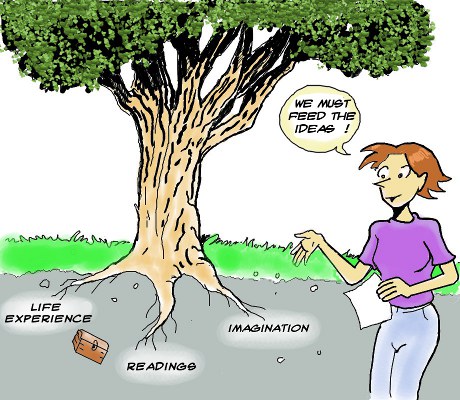
So, our inspiration tree must be fed, in three ways. We draw first from our own life experience, that help to get empathy with what our characters are living through. Then by our readings, any kind of reading: for researching our subject, for fun, for exploring different genres and ways of storytelling.. and last but not least, our imagination, always creating bridges.

The inspiration Tree

Many of those links may be absurd, but some will prove fecund.

A writer cannot get into an ivory tower and tell himself that his fertile imagination will be enough. Our plant needs watering, fertilizer, care: the three inspiration sources interact between themselves. And when the story gets too profuse, the care will later include pruning

(to be continued…)