Random bag of kindness

a Mississauga bus

Waiting for the bus under a pelting rain is not always conducive to happy thoughts. Moreover, this morning of september 16th, I was en route to a Press conference of Ecole Polytechnique alumni in Toronto ( about the long-gun registry). When I took the 89 bus in Mississauga (not the no 1 on this post, taken from the Wikipedia creative commons), I would be different…

I sat my drenched weary self on the second bench from the front. An African Canadian  lady was seated in the first row.

A young Asiatic girl got on the bus, with an overload of lunch, a big plate, other trinklets and smaller bags escaping her hands. She flashed an apologetic smile around as she recaptures a trinklet.

The black lady foraged in her handbag and offered a reusable shopping bag. She helped the girl to put all her things inside. Until this time, I thought the two of them knew each other. The young girl thanked the lady and walked farther back to sit by herself.

reusable shopping bags; the lady had the blue one with a green leaf on it

How nice! I though with a sunny smile inside. (A reusable grocery bag sells one or two bucks a piece.) But it was not over yet.

A minute later, the girl came back to the front, with the empty bag. She thanked the lady, telling that she managed to reorganize one of her bag to get the rest in it, and she returned the bag.

There are many sad things occurring in our lives, but this one random act of kindness brightens this rainy day.

The older woman got out at her stop a few minutes later. From my angle, I never saw her face.

Must have been a guardian angel.

The secret well of ideas

The secret well of ideas !If there is one question that every published author hears at other events, it is this one : But where do you get all those ideas ?

Secret well of ideasMany people who dream of becoming a (famous) writer are scratching their head to find this mysterious well of ideas. Most are under the impression that writers form a tight circle around a secret lair of the golden-egg-laying hen. The secret well of inspiration, teeming with ideas!

This belief joins another one : all writers signing at the events are filthy rich!  Or if they are not, it must be because they don’t have access to a good well.

This in nonsense, as chance and fashion are the capricious ingredients that make or unmake successes. Also, many are convinced that once this idea has been fished out of the well, the main work is done, the book will write itself! Hence this ubiquitous anguished question : will someone steal my idea?

Relax, it is rather the opposite. Ideas are like dandelion seeds, easy to blow : pfffffuit!

Chaaas blowing dandelion seeds

They are blown in the sky half-formed, and many budding writers try to capture them with  clumsy fingers ! When they manage to catch one, they notice that there is still a long way  between the seed and the grown tree, between the idea and the completed book!

About ideas, the following scene happens often at a signing table (preferably when the writer is alone). A fan walks by, telling of his wonderful idea for a novel, an idea so genial that the writer should leave all his current projects to do the hard work on it! It happens especially with the SF writers…

An idea may be a very small seed at the beginning, so we must not try to pull from it a completed 600-page spy novel !

Imagine if the writers worked like that!

(Who is this author?)

Les Nuages de Phoenix (The Clouds of Phoenix) was my first SF novel aimed at YA. The novel idea took a long time to grow.

It began with a simple mental picture, a girl looking at the clouds. One of my favorites activities when I was a child. I happened to like meteorology (and I later followed climatology courses when studying Geography). The place took form, Phoenix is another planet with a green sky. Why green? Ah, enter the airborne particles size, and many other explorations.

In that special environment, I found out that the little girl, Blanche,  was handicapped, a consequence of a grave accident, and she wears an exosqueleton that gives her legs the capability of running at 80 km/h (a fun fact when I mention it in classrooms). New characters appear : Blanche has a family: an big sister in love , a father worrying about the oxygen production plant, etc.  Those characters grow and eventually become like friends of the writer. This is a very nice step in the creative process, and I will come back to it in a future blog entry.

Cover of Les nuages de Phoenix

The clouds of Phœnix‘s seed idea took about one year to grow discreetly, before I was ready to write the full-length manuscript. Afterwards, there has been the long rewriting and edition process under my editor’s eye. All in all, the novel took almost two years (working on it part-time) between the seed and the finished work.

I wrote about the challenge of growing a story in my French blog. A story begins as a tiny seed, which we put in soil and water, leaving it for a time. But the idea grows in silence. And nothing prohibits us to have more than one idea growing! Certain will get ripe earlier than the others.

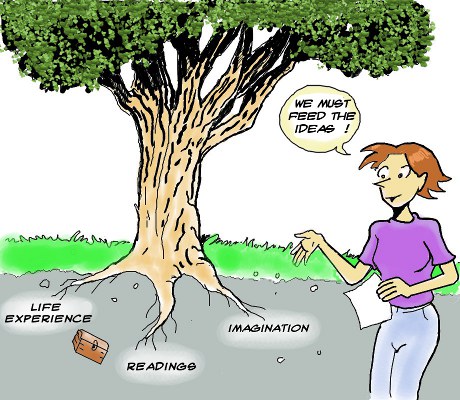
So, our inspiration tree must be fed, in three ways. We draw first from our own life experience, that help to get empathy with what our characters are living through. Then by our readings, any kind of reading: for researching our subject, for fun, for exploring different genres and ways of storytelling.. and last but not least, our imagination, always creating bridges.

The inspiration Tree

Many of those links may be absurd, but some will prove fecund.

A writer cannot get into an ivory tower and tell himself that his fertile imagination will be enough. Our plant needs watering, fertilizer, care: the three inspiration sources interact between themselves. And when the story gets too profuse, the care will later include pruning

(to be continued…)

Census and sensitivities

Population Growth

Prime Minister Harper, catering to the sensitivities of  his ever-dwindling base, decided to cripple an instrument in perfect working order, who never gave a peep of distrust before. Soon, the above graphic may well be the only reliable demographic information gathered by Stat Can…

The compulsory long-form census, filled by one fifth of Canadian households, will now be facultative in 2011. Protests by statisticians, demographic experts, economists and researchers in the field have been poo-pooed by our Prime Minister and his cabinet ministers. The resignation of Munir Sheikh, head of Statistics Canada did not even budge them. The King has ruled.

Conservatives and libertarians called defenders of the mandatory long form census “elitists”. It seems that education, efforts, and reaching excellency in any field, is now a capital sin.  Financial, artistic, scientific elite, all the people who works hard and long to obtain results, are now so easily dismissed, especially if they do not espouse the right ideology.

The King Harper government began by accusing the long-form census of threatening citizens with jail term (and fines, but only jail was mentioned at first). A quick check by journalists found out that nobody had ever been imprisoned for refusing to take the long form census.

Also, the growing opposition of a vast part of the population (citizen’s groups, organizations, businesses, university researchers…) had the Conservative Caucus come up with a new gem yesterday. Minister Tony Clements said opposants “got a good deal” with the wealth of reliant information coming from the Census. And that they want “an easy ride”. An easy ride. Let’s see: isn’t a responsible government supposed to collect the best and most accurate information about its population before taking decisions affecting said population?

Without bothering to consulting any expert, (except their own ideological think tanks), Clements affirms that changes to the census will not affect the quality of data collected, even though statisticians warn a voluntary system will not be as accurate. “If they (insert names of a hundred and more names of organizations, businesses, charities, universities) don’t want to use that data, it’s up to them. They can pay for it another way. … You don’t have to rely on the government of Canada.”

They can pay for it…

Tadaaaa! Another victory for those who dream to cripple, then eventually scrap any governing bodies. (Law of the fittest, rings a bell? ) You need accurate info on the population? Got to pay for it from your own pockets! See the 2001 results of Census Canada.

So how will we replace the Census mandatory long-form as a reliable information collection ? Phone surveys? How does cost a phone survey on any particular subject? And who, pray will manage those surveys?

Private companies. Here is an idea of some cost, according to a Phoenix company:

Costs for a 400 persons phone survey (in US$):

For more information, here is another survey costs comparison (from the private sector). Remember that answering the survey is not mandatory…

Survey Type                          Cost per Survey Response* (many attempts needed before getting a valid response!)

Telephone Survey                       $10.00

Mail Survey                                  $56.37  (why this high figure? because there’s no mandatory answering)

Automated Voice Survey         $3.50

The phone survey costs looks cheaper than the mail survey to replace the long-form census. But oops! Are you happy to get all those telemarketers and polls calls home? Me neither.

There is, also a growing concern about the future of phone surveys. The increase in ‘do not call’ refusals, they found that phone surveys with automated random digit dialing are no longer representative of the US population, as land line telephones now skew to older respondents.

Back to the scrapped mandatory long-form census, replaced by private companies’ polls.  Take the 400-persons survey example. For a good 30 minutes (25 000 US $). Now, multiply this number for one fifth on the Canadian population, that would be around 6 millions people, about 1,5 – 2 million households ?  93 750 000 US$ . This is a conservative figure, since I took the smallest number of households, and a very short phone time (not many people wants to spend more than 15 minutes on the phone). If we change idea and take the mail survey (the number of questions is not specified on the price tag) for 1,5 millions households, the results won’t be more reliable.

A mere 400 to 3000 respondents  poll on one specific question cannot reach the reliability of a Canada-wide Census with a lot of correlating data. Since neither poll or survey will be mandatory…

That’s why a Canada wide,  reliable census every 5 years is essential part of governing. It provides a solid base on which public policies – social, cultural, economic – are built . The sensitivities of  a few paranoid citizens about the revealing the number of bedrooms in their homes have no base in reality. Stat Can has always taken measures to protect privacy.  The Statistic Act  requires that the information provided be kept confidential. The National Statistics Council has supported changes to data collection methods that enhance privacy, such as mail-in and on-line option. On the other hand, credit card companies ask for a lot more info, and exchange them gladly over with banks and other businesses…

What does the Harper decision means is that only the richest will be able to afford reliable demographic information.  Oh, you’re a very small business, a volunteer, a charity, a NGO, Centraide? Tough. And if you know the kind of biased questions asked by the polls by political parties, imagine the flood of “surveys” after the access to reliable infos, Stat Can Census, will have been crippled.

Moreover, this whole Census affair shows that the Harper government will be building its actions and politics  not upon reliable and scientific evidence, but upon their own ideological construction of reality. Climate change? Pollution? Criminality? Creationism? A set of beliefs will now reign, unchallenged by science.

Two new publications

Two new publications will be out for my birthday (July 14th) .  First, my Award-winning SF short-story  “Monarque des glaces” has been published in Solaris 175. The story depicts a dystopia set in an Earth reeling from a series of drastic climate and ecological changes.

The flower photo refers to Marguerite Andersen, the courageous editor of  the literary magazine Virages.  She does all the clerical work, despite the  recent cuts.

Marguerite is also the author of le figuier sur le toit , a precious personal account of life in Germany, in the pre-Nazi years. Germans were not a monolithic bloc, there were a diversity of opinions and political parties… until the elections of Hitler in 1933.

All this to proudly announce that another of my stories, “Château de neige”, will be published in the next Virages.

Nature’s gifts

Those days, our raspberry plants gave us oogles of little berries! A generosity I wish humans could imitate…

Framboises

This stick bears at least 300 fruits (I counted them!) hence, the shack was put to contribution!

utilité du cabanon utilt du cabanon

We had a morning visitor on the June 24 St-Jean: an oppossum making his rounds on the patio. Our two cats were anxious…

Opossum

At the end of the afternoon, another family member tastes the fruits!

Cueillette

The silent destruction of creativity

A writer's career path before the restrictions

The new Canada Periodical Fund (replacing the Publications Assistance Program/Canada Magazine Fund) will exclude any Canadian print magazines without 5000 copies sold per year.

It means that most of the French literary magazines that published my first efforts will be excluded! Among those,  Solaris, Virages and Ciel Variable, all running at less than 5000 copies a year.

I guess I can safely add the SF magazine On Spec to this list.

Although this number is aberrant for the French publication, who get the same minimum floor as the English ones, even if their readership is way less, (the ratio anglo/franco is  3 to 1. Meaning, a fair requirement would have been of 1250 copies for the pour the French magazines. (Thanks to Jean Pettigrew, publisher of Alire, and the magazines Alibis and Solaris, for this precision).

The same path, after the restrictions

This text (in French) on the Devoir website, by Jean Larose, explains the consequences of those new restrictions. After making away with the literary broadcasts and gutting Radio-Canada, for being “elitist” (that is a sin to educate people), it’s the turn of cultural magazines to taste the conservative medicine.

By transforming culture as a big-buck entertainment industry, by uniformizing the product, the government cut the next generation af writers and artists from a well of creativity, that precious resource helping humanity to cope with the challenges coming our way. And the more for Science-fiction. SF is a patchwork of ideas, thought-provoking scenarios, unlocking the reader’s imagination.

Author of Life of Pi, Yann Martel, explained how his literary career began with a small Vancouver fanzine who published his first efforts.  This humble publication pronged him to persevere in writing. He also appreciated his first writer’s grant, on the website http://www.whatisstephenharperreading.ca/about/ :

I, for example, represented 1991, the year I received a Canada Council B grant that allowed me to write my first novel. I was 27 years old and the money was manna from heaven. I made those $18,000 last a year and a half (and compared to the income tax I have paid since then, an exponential return on Canadian taxpayers’ investment, I assure you).

In the same way, Solaris and Ciel Variable, then Saisons littéraires and Virages published my first efforts.

In 1987, I had a poetry and a text published in number 2 and 5 of Ciel Variable. There, I met Hélène Monette, who also had her first poems published.  Now, more thant 20 years later, Hélène’s work, provocative, full of intellectual dynamite, was recognized by a GG award, (mine by a GG nomination the same year).

I take this occasion to thank warmly Solaris. In ten years, I passed through the entire cycle: a beginner, I received rejection letters. But those letters came with explications and commentaries that helped me to improve my writing. Solaris’ editors, Yves Meynard, then Joel Champetier, did that work, mostly on a volunteer basis.

Their advice led me to have nearly 10 novels published, six to eight literary Award and countless nominations (among them, the Trillium and GG awards) . The Jules-Verne Saga were a by product of a short-story initially refused by Solaris.

I would like to tell you that since those days, I have become a successful author with a large following of millions worldwide. That would be the only form of achievement that the Conservative government would respect, of course. Nevertheless, I am proud of writing my books and giving my lectures and workshops, dispensing encouragements to the young generation. The results are less tangible but, as with plants, they grow in silence.

I owe all this to the small publishers. If their -very modest – grants are cut, they will have more difficulties to survive. The  next generation of creators will be starved, denied the sunlight necessary for their growth. The competition will be fiercer for less publishing space, where official recognition will go to more popular and more vapid entertainers…  Overall creativity will suffer and dwindle, leaving less space for thinking. (see my other post there).

I leave the conclusion to Yann Martel, a citation from the same source

I was thinking that to have a bare-bones approach to arts funding, as the present Conservative government has, to think of the arts as mere entertainment to be indulged in after the serious business of life, that—in conjunction with retooling education so that it centres on the teaching of employable skills rather than the creating of thinking citizens—is to engineer souls that are post-historical, post-literate and pre-robotic; that is, blank souls wired to be unfulfilled and susceptible to conformism at its worst—intolerance and totalitarianism—because incapable of thinking for themselves and vowed to a life of frustrated serfdom at the service of the feudal lords of profit.


Embrace Life

I don’t do that often, but, I can’t resist linking this example of what good publicists can do, at the top of their art.

Guy imitating the act of driving a car in his living-room

The British organism Sussex Safer Roads Partnership (SSRP) concocted this pub to promote of wearing their seat belts.  But without any pathos or blood, like the ones we had in Canada a few years ago.

the link:

http://www.embracethis.co.uk/

I won the 2010 Solaris Prize!

About one year ago, a Britannic webzine asked for short texts, one or three hundred words max, describing the future in one hundred years, and in the spirit of “mundane” SF. Mundane is a term coined by author Geoff Ryman to describe a “down-to-earth” approach to science-fiction stories.

I jotted a few ideas of a bleak future from which grew an embryo of text. I reworked it… and exceeded the word limit. So I left the text alone for a while.

One or two months later, I took the text back and managed to fold it into a story, with a bird-eye point of view by an unlikely character.

As the Solaris Prize deadline approached, I decided to work on it again, and polish it. The story finally grew strong and mature enough. So, like a child that I am proud of, I let it go…

And I received the good news last week. I’m a proud mother! The Prize includes a generous sum, plus the publication in the Solaris magazine.

The official communiqué (in French) is here

Great expectations

More and more, the time lag separating athlete’s position is dwindling. The performance were evaluated in seconds, then, in tenth of seconds, now in hundreth… Soon, in three decimals after the second?

Drug use is the great temptation for an athlete who gave up so much of themselves for the podium. The genetic lottery favors some more than other. Hi-tech materials and fabrics do the rest. Despite the tech, a youth comes so close to the podium…

Do you remember the 2nd, 3rd place in a game? (And the fourth, which I call the chocolate medal). In those great expectations, with the new drug tech emerging each year, the temptation is strong… for the athlete and or the trainer! And woe to the stadium star who has fallen!

And the efforts sometime do not bring the results. We saw a sad accident happen.

We heard the commentators for weeks: Canada should bring 15 medals, no 20, and at least 5 gold…

I do not like this attitude of “reserving” medals, as if it were a due. Many countries, with few means, will live the Olympic ideal, participate without winning. And 8 or 10 developed countries, pouring millions in training and trinkets (while the province of BC cut the art budget from 46 millions to… 3 millions), make the prognostics.

So: all athletes won’t win the first place, but all will participate. And it is an accomplishment just to be chosen for the Games…

To all of you, athletes, I give the chocolate medal, 65% cocoa !

:^)

_Great Expectations_ refers, of course, to the Charles Dickens’ novel.

A worker-at-home’s move…

A useful remainder

I don’t know if you are a worker-at-home like me, but getting to answer to all the gas-marketers, electricity-marketers, after-life marketers… knocking at your door is time and energy-consuming.

Here is a nice thing I drew on a whiteboard with markers. I can enjoy tranquillity at last!

Now, to tackle those pesky telemarketers… and their elusive bosses!